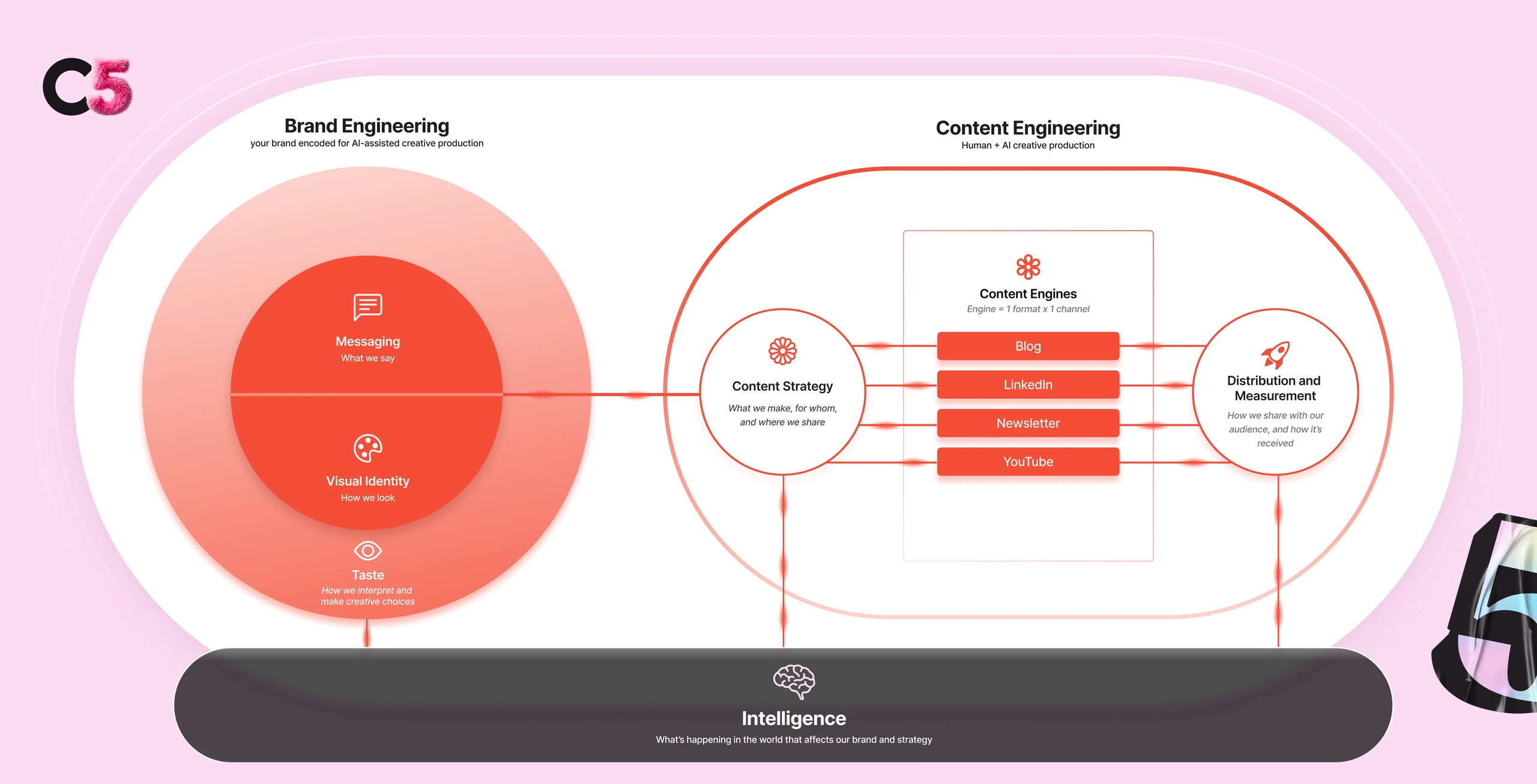

Security is invisible until it fails. When it fails, everyone sees it: the board, the press, and the customers now reading a breach-notification letter. That asymmetry shapes every content marketing decision a cybersecurity company makes. As a result, the brand platform has to earn trust before anything has actually been prevented. The technical content for practitioners operates under the same pressure. This guide offers a framework for a program that earns CISO-grade trust. In this category, buyers take 12 to 18 months to decide. Along the way, they consume more content before a first call than in almost any other B2B vertical.
Why cybersecurity marketing starts from the invisible-until-it-fails problem
In most B2B categories, buyers can try a product, see outcomes, and decide. In cybersecurity, however, the buyer wants the absence of a headline. As a result, the content program has to make that absence credible before anything has been prevented. That puts the emphasis on trust, track record, and felt competence. Feature comparisons matter less here.
That structural condition has three downstream effects. First, the category sells the prevention of something catastrophic, rather than the delivery of something desirable. That framing flips the usual “show the upside” logic on its head. Second, when failure happens, it becomes a boardroom event. Every asset a vendor publishes today therefore has to hold up in the worst case. Third, buyers know all this. They compensate by running the longest, most thoroughly researched evaluation cycles in B2B.
Enterprise cybersecurity deals typically take 12 to 14 months to close. The broader range is 9 to 18. Along the way, buyers consume 13 or more pieces of content before a vendor conversation. Often more than half comes from third parties, not vendor sites. That’s the environment a content program has to hold up in. You don’t get one shot at the buyer. You get twelve or fifteen. Meanwhile, analysts, peers, and AI tools are also weighing in.
Compare that to other B2B narratives. For example, product-led storytelling has more room to move. The product’s value is visible on demo day. Cybersecurity, by contrast, doesn’t have that shortcut.
The brand choice: heroism, fear, or something in between
Cybersecurity brand teams work with a narrower set of cards than their peers. The category’s default emotional register is fear. Leaning into that produces two problems. First, fear-mongering cheapens the brand. It reads as disaster merchants selling insurance against the apocalypse. Second, brand leaders don’t want to be the people doing that. After all, most brand practitioners didn’t get into the work for impending-doom messaging.
The alternative most capable brands reach for is heroism. That approach means epic, graphic-novel-adjacent storytelling. Sometimes it gets comic-book-tinted. In this mode, the buyer plays the hero of a recognizable narrative. Sometimes the vendor shares that hero role. Of course, the execution rarely lands at the Marvel end of the spectrum. It doesn’t need to. Ultimately, framing around strength, capability, and confidence does more work. Framing around the threats themselves does less.
There’s also a third register worth naming: stoic-technical. This mode runs on quiet confidence and minimal drama. It relies on a heavy diet of proof. In practice, it works for brands whose buyers skew toward the security engineer. This register also sidesteps the fear trap, as well as the risk of looking theatrical. In reality, most brands operate somewhere on the spectrum between heroism and stoicism. They tune the mix to the audience they need to move.
How Column Five has built this platform in practice
Column Five, for example, has built this platform with HackerOne. The work repositioned the category around a concept called Cyberstrength. That frame moved HackerOne past defensive “ethical hacking” messaging. In addition, it positioned the brand in a proactive posture. CISOs could actually get excited about it. In parallel, campaigns like Anatomy of a Breach show a different lever. They treat security storytelling with the depth and craft of editorial journalism.
C5 has done this work across the category. Cybersecurity and identity engagements include SentinelOne, HackerOne, and Cylance. They also include Auth0, Okta, and CLEAR. In addition, security-as-narrative work extends to Microsoft, Roblox, and Salesforce. For those clients, security is a core story even though the company isn’t a security vendor. The common thread is a brand platform. It makes room for the threat without making the threat the hero.
The buying committee, and what each person actually reads
Cybersecurity buying committees have grown in size. The average was 6.2 stakeholders in 2021, 8.1 in 2024. Projections pass 9 by 2026. As a result, the content program has to serve all of them. It can’t just serve the person at the top.
The four readers on the buying committee
The CISO. The CISO’s job is to let the rest of the executive team sleep at night. They care about risk posture and incident reduction. They also care about vendor track record after a breach. Will this vendor still look like a smart choice if a breach happens? 41% of CISOs cannot correlate security spend to risk reduction. Meanwhile, 82% report that incident reduction is the primary metric they use inside the business. Content that helps them make the case internally is the kind they forward. Ideally, it doesn’t ask them to stake their credibility on marketing claims.
The security engineer or SecOps lead. This reader consumes technical content. That includes emerging-threat writeups, configuration guides, detection labs, and post-mortems. By contrast, marketing language registers as noise. Consequently, a vendor loses this reader in ten seconds if the content doesn’t hold up.
Procurement. Procurement needs compliance documentation, reference customers, and pricing transparency. In short, this group wants clean answers over editorial voice.
The CFO or budget owner. The CFO wants the incident-reduction story translated into financial framing. That framing includes expected loss avoidance and insurance-premium impact. It also includes audit-ready evidence of improved cyber risk posture.
In effect, four different people are evaluating the same deal. Each one reads a different kind of content. Serving only one of them (usually the CISO) leaves three-quarters of the committee unaddressed.
The content formats that do the work
Running in parallel to the brand platform are two content tracks. They have different audiences and different jobs.
The brand-led track carries the platform. This is where original research and executive thought leadership live. It’s also home to documentary-style video, interactive explainers, and more ambitious storytelling formats. This content shows up in LinkedIn feeds and industry press. It also shows up in board-member conversations. Those audiences often hear about your company before they hear about your product. Original research is the single highest-leverage asset in the category. For example, a well-designed research report can drive six to twelve months of pipeline. It can also drive analyst attention and sales conversations from a single investment.
The technical track carries credibility with practitioners. This is where threat writeups and front-line learnings live. It also hosts customer case studies, detection guides, technical documentation, and post-incident analyses. Polish matters less here than accuracy and timeliness. It also matters less than the voice of someone who clearly knows the material. 81% of engagement on cybersecurity topics happens on editorial and non-sponsored content, not on vendor websites. In other words, the technical track has to earn its credibility elsewhere.
Most content agencies produce only the first half of this stack, which is editorial. The format range a cybersecurity program needs is wider. It includes editorial, video, and motion graphics. It also includes data visualization and interactive pieces. And it covers sales enablement assets and research reports. All of those live under a single brand platform. Getting the strategic foundations right before scaling any single format is key. Without that, the two tracks feel like they came from two different companies.
The AI twin-thread every cybersecurity brand has to confront
AI shows up in cybersecurity content marketing on two sides of the ledger. Both need a position.
AI threats are moving faster than defenders are
AI-enabled attacks are emerging faster than defenders are adapting. The attacks include large-scale phishing generation. They include deepfake social engineering. They also include autonomous vulnerability discovery. The arms-race dynamic is already here. Attackers use AI to generate campaigns at scale. Defenders use AI to surface signal in the noise. Both sides are compounding on their last advantage. Meanwhile, every cybersecurity company now fields a question. How does its story relate to AI? A brand platform without a posture on this looks outdated inside twelve months. The posture can be pro-AI, AI-cautious, or AI-skeptical. Whichever it is, it has to be specific. It also has to connect to how the product actually works.
Answer engine optimization is already a current-quarter priority
You’re reading this article. That probably means you open ChatGPT, Perplexity, or Google’s AI Overviews weekly. You already know how those tools surface vendors. In fact, you’re using them yourself to evaluate your shortlist. Because of that familiarity, answer engine optimization has become current-quarter work. For example, 49% of marketers report declining traditional search traffic from AI answer engines. Meanwhile, 58% say AI referral traffic converts at higher intent. That combination rewards brands that structure content for AI pickup.
Two companion pieces are worth reading. The first covers why AI search mentions convert five times better than Google traffic. The second lays out the three pillars of AI visibility. In short, AI visibility is a brand problem as much as an optimization problem. Cybersecurity brands that skip it are already giving ground. Meanwhile, competitors thinking about AI visibility are winning those gains.
A framework for a cybersecurity content program that compounds
Here are five moves, in order.
- Lead with a brand platform that sits above the fear/heroism line. The platform is the thing every other asset inherits from. Built well, it lets you talk about threats without sounding like a fear merchant. It also lets you talk about strength without sounding performative.
- Run two content tracks in parallel. Deliver brand-led content for the committee’s strategic audience. That audience includes the CISO, CFO, and board. In parallel, deliver technical content for the practitioner audience. That audience includes SecOps and security engineers. Don’t collapse the two tracks into one voice.
- Invest in original research. One well-designed annual research report carries six to twelve months of pipeline. It also carries press and analyst attention. Cybersecurity is especially receptive to original data. The industry runs on threat intelligence.
- Take a position on AI, on both sides of the ledger. State where your company stands on AI-enabled threats. Also state how your product uses AI to respond. Every cybersecurity brand will need this posture. Ultimately, getting there first pays off.
- Structure every asset for AEO pickup. That means definitions and numbered frameworks. It also means consistent heading patterns, named entities, and clear Q&A blocks. Cybersecurity buyers are already using AI search to evaluate you. As a result, the content has to be machine-parseable as well as human-readable.
What to look for in a cybersecurity content marketing partner
If you’ve gotten this far, the next step is shortlisting agencies. Two resources are worth your time. The first is the cybersecurity content marketing agency comparison. It profiles agencies that specialize in the category. The second is the broader SaaS content marketing agency list. It covers agencies whose cybersecurity work sits alongside B2B SaaS experience.
The short version of what to look for comes down to four things. First, the agency should name cybersecurity clients it can point to directly. Second, the content stack should go beyond editorial to include multiple formats. Third, the work should show evidence of brand-platform thinking. It should go beyond blog production. Fourth, the agency needs a clear point of view on AEO. Cybersecurity content marketing is a game of trust and credibility. The winning partner helps a CISO’s company stay ahead of what’s coming. If your shortlist is still taking shape, get in touch with the Column Five team. We’re happy to walk you through what a program could look like for your company.
Frequently Asked Questions
How do cybersecurity companies use content marketing?
Cybersecurity companies use content marketing to build trust and credibility. That trust has to be strong enough for a CISO to stake their own credibility. The program usually looks like a brand platform at the top. Underneath, a technical content program runs in parallel. The brand platform includes executive thought leadership, original research, and campaign storytelling. Meanwhile, the technical program includes threat writeups and detection guides. It also covers case studies and post-incident analyses. As a result, the program compounds over the 12-to-18-month sales cycle. Buyers who’ve consumed 13 or more assets before the first call show up already convinced.
What type of content works best for cybersecurity marketing?
Two kinds of content work here. Original research and brand-platform storytelling earn the CISO and board audience. Technical, practitioner-voiced content earns the SecOps and security-engineer audience. In contrast, product feature lists, generic “top 10 threats” posts, and recycled industry statistics don’t move either audience. They usually signal a vendor that doesn’t understand the category.
How long is a typical cybersecurity sales cycle?
Enterprise cybersecurity deals typically run 12 to 14 months. The broader range is 9 to 18. Smaller deals move faster. However, even those tend to involve multiple stakeholders. The nature of what’s being bought makes fast decisions rare.
Who are the buyers of cybersecurity solutions?
A typical committee has eight or more stakeholders. The CISO owns strategy and risk posture. SecOps and security engineering leads handle technical evaluation. Procurement covers contracts and references. The CFO or budget owner translates the program into financial framing. Sometimes the CTO or board joins as well. Each stakeholder reads different content on different channels.
How should cybersecurity brands talk about threats without fear-mongering?
Brands do this by leading with capability rather than catastrophe. Name the threat, but position the brand’s response as the narrative center. Heroic, platform-led storytelling gives buyers a brand to identify with. HackerOne’s Cyberstrength positioning is one example. That identification is a stronger emotional pull than fear. Fear gets clicks. Capability gets contracts.



Let's upgrade your marketing game
Get fresh tips, how-tos, and expert marketing advice every week. (15,000 people already are.)