
AI hubris is the gap between what AI was promised to do and the rash, often costly decisions companies have made on that promise. This article unpacks the mechanics and effects of AI hubris, walks through where the bill is already coming due, and lays out what marketing leaders can do differently.
Understanding the Moment: Harder Than It Sounds
In the surreal, ominous early days of the generally surreal and ominous era that we now reductively refer to as “the COVID days,” I had something of a dustup with a member of my personal network. (Humor me here—I swear this is going somewhere.)
He’s a restauranteur, and in the first days of the pandemic, he made an Instagram post lauding customers for continuing to dine at his restaurants and support the industry.
Reading the post gave me a sense of horror, as it seemed his message was flying in the face of the epidemiologists’ advice to socially distance. I commented on the post with something pretty direct, probably verging on grandstanding, to the effect of “This post may cost people their lives.” We ended up discussing it a bit and sure enough a few days later, along with the rest of the country, his restaurants closed up shop for a few months.
This story now feels parable-like in relation to the current moment in AI marketing. The difference in our postures regarding the pandemic, and decisions whether to go out or stay home, centered on our understanding of the current, larger “moment,” and how we as a society should be behaving ourselves.
Out Over Our AI Skis
In those early COVID days, any number of boardrooms, chat groups, and thought-leader articles unpacked the question of “What should we be doing?” but also many other questions beginning with “When?” When do we close the offices? When do we make a rapid lifestyle change? When do we reopen schools? These “when” questions, which represented the crux of my personal spat, sparked much of the COVID-era debates.
We generally agreed what direction things were heading, but the tricky part was knowing when to implement change.
Generative AI is sparking the same types of questions, as company leaders and teams alike seem to all agree that major change is underway.
But the most interesting questions start with “when?”
- When should we adopt AI tools?
- When do we stop hiring?
- And my favorite: When do we go all-in?
It’s clear what moment the market wants us to be in.
For the past 18 months or so, the utopian promise of AI efficiency has led companies to reorganize, cut headcount, and rewrite strategy. And the market has largely rewarded this posture: In earnings call after earnings call, company leaders have been eager to announce large layoff numbers to boost their share prices.
AI Hubris and the Misjudgement of the Moment
In case after case, we’re seeing minimal, or even opposite, impact from the promised AI efficiencies.
Gartner studied enterprises that piloted AI or autonomous technology and found 80% of them reduced headcount, with zero correlation between those layoffs and AI return on investment.
Meanwhile, compute has gotten expensive faster than headcount has gotten cheaper, and headlines this week have suggested that corporate leaders are noticing. Nvidia’s VP of Applied Deep Learning Bryan Catanzaro told Axios that for his team, “the cost of compute is far beyond the costs of the employees.” Uber burned through its 2026 AI budget in four months.
And then there is Block. Jack Dorsey cut 40% of the company (roughly 4,000 people) and credited AI as the reason a smaller team could “do more and do it better.” Four days later, a design engineer was quietly brought back, having been the sole person maintaining critical infrastructure for Square and Weebly customers. Others have followed in similar quiet rehires.
Then there are the cases where an AI agent with credentials actively breaks something. The Cursor coding agent, running Anthropic’s Claude Opus 4.6, deleted the entire production database and all backups of car-rental software company PocketOS in a 9-second API call, causing a 30-hour outage.
Likewise, B2B marketers are discovering there’s a big difference between what AI was promised to do and what it’s delivering. Still, that gap hasn’t seemed to interrupt the speed at which leaders have made expensive, often irreversible decisions on that promise.
Brand Drift: Slop, Watermarks, and the Erosion of Distinctiveness
The headlines are beginning to coalesce around the idea that perhaps companies were a bit too trigger-happy with AI; that, while they read correctly about what was coming, they miscalculated the when of it all.
Of course, it hasn’t been silent at all for those on the front lines of brand communications because they’re dealing with the repercussions every day.
Mentions of “AI slop” in media monitoring have increased ninefold over the past year, and 41% of marketing leaders call it a real challenge. Canva’s 2026 Marketing AI Report found that 70% of consumers say AI-generated ads feel like they are missing something, and 87% say the best advertising still requires a human touch.
Subtler still is the watermark problem: plenty of AI-generated content is grammatical and factually defensible. What gives it away is the predictable opening, the same three-item list every time, the executive summary that explains the article it sits on top of. Readers recognize it as generic even when they cannot name what they are noticing. For a brand whose differentiation depends on having something original to say, that is the opposite of scaling.
What This Means for B2B Marketers (The Golden Rule of AI Brand Systems)
Marketing leaders sit in a particular pinch. On one hand, every CEO email from the past 18 months has included some version of “we need to be using AI more aggressively.” This pressure from above isn’t likely to ease up anytime soon.
On the other, every brand standard from the past 15 years has said the work needs to feel like the brand.
Holding both at once has produced a generation of campaigns that look like the brand from far away and feel like nothing in particular up close. Most teams already know it, and the current playbook of “just use the tools more” will not close the gap. The longer it runs, the closer AI hubris gets to becoming brand hubris.
So we’d like to propose a golden rule of AI brand systems: AI must serve the brand, never diminish it.
It’s a simple rule, but it would make many marketers think twice about what they’re putting in market right now.
Quality and consistency are sacred to brand marketing, and AI is a tool to help brands scale—but not a license to ship something lesser. Adopting AI is a real unlock, and the output must never fall short of what the brand’s keepers would create themselves.
AI for B2B Brands: Seizing the Moment
The path forward keeps AI in the loop and asks more of how the loop is designed. The teams who will look smart in the next 18 months are getting five things right.
Treat your brand as the moat. Our Best Story Wins thesis has only sharpened with AI: products and services in tech are increasingly replicable, and AI has accelerated that reality. As a result, the remaining durable asset is brand: what the company stands for, the story it tells, the way the work feels. In ship navigation, a one-degree change in heading translates to hundreds of miles of difference at the destination, and brand works the same way. When a brand is properly differentiated, AI-assisted output points the right direction. When the brand is generic, AI scales the drift.
Treat AI as an experiment until results are repeatable. Most marketing teams skipped the discovery phase and went straight to mandate. Instead, AI deserves the same discipline you would apply to any new vendor: pilot it on bounded work, measure quality and brand-fit honestly, and treat “works in a demo” as a long way from “works at production volume.” Creative work resists shortcuts in particular: the parts that involve taste and judgment are still the parts where rushing makes the work worse.
Know what content is for machines, and what is for humans. Increasingly, content has two readers: the human who might buy something, and the AI model that might cite something. Machine readers reward structure, claim-density, definitions, and FAQ blocks. By contrast, human readers reward voice, specificity, and the sense that a real person is behind the work. In practice, the strongest content programs design for both, with different formats for different audiences.
Invest in people and systems, in that order. The brands that came out of the past 18 months looking smart did not eliminate experienced senior creative staff. Instead, they kept senior judgment at the top of the workflow, with AI tooling layered underneath to handle the work that did not need judgment. After fifteen years of helping enterprise tech brands scale their story, along with many of the conversations on our Best Story Wins podcast, the same lesson keeps surfacing: senior judgment is the part you cannot delegate, however many models you add downstream.
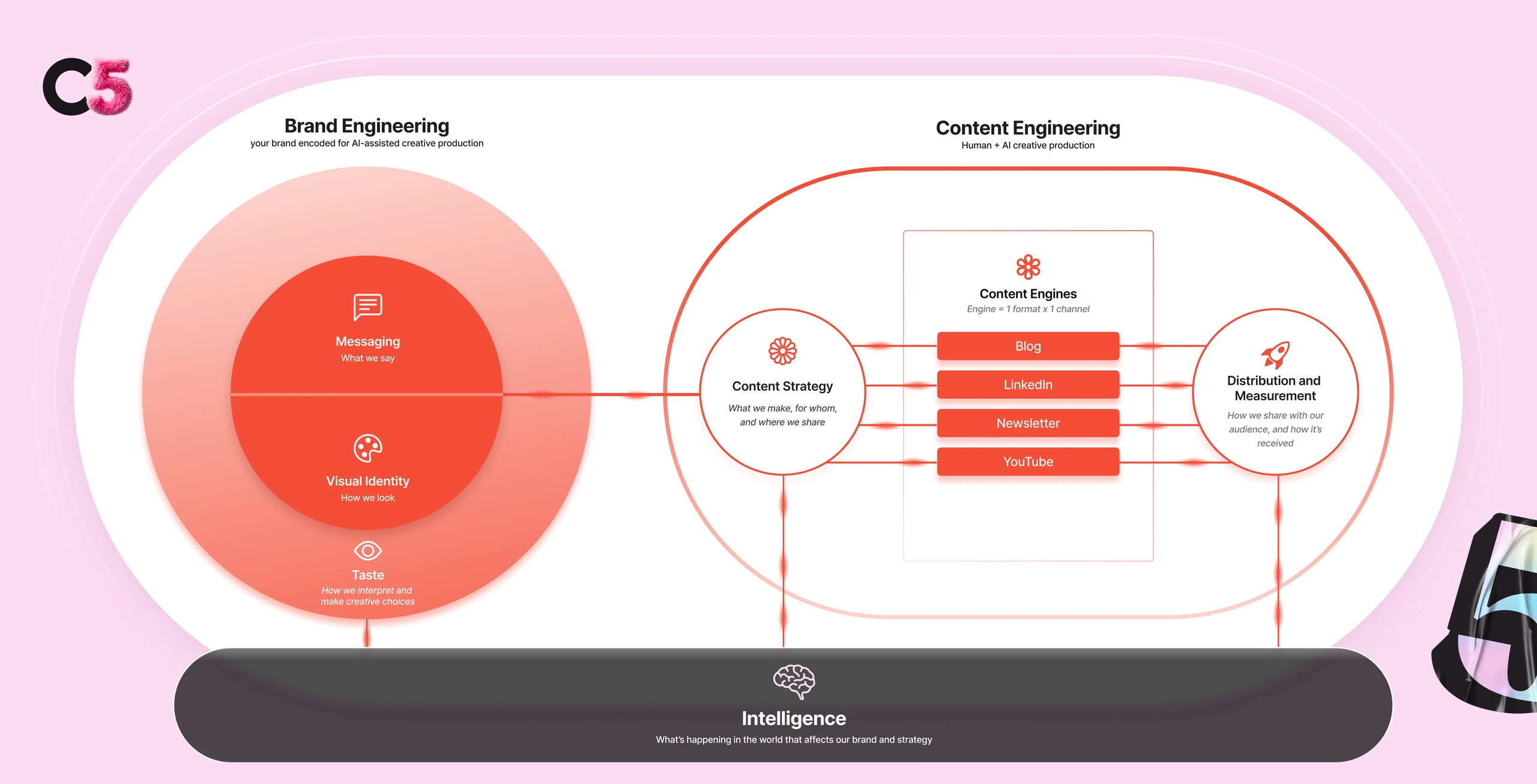
Bake the brand into the AI loop. The hardest thing to scale with AI is the brand judgment that has to be applied to every piece of work: style, tone, fact-correctness, alignment with positioning, knowing when a particular angle is off. Delegate any of that to an unbounded model and you get slop. The fastest-moving teams are starting to encode brand judgment as structured governance, with explicit guidelines the AI is held to before output reaches any human reviewer. We are building one ourselves, a beta tool with the working title Brandcode, because the available options in the market do not meet the standard a senior brand team would accept.
None of this is the dramatic, sweeping answer the “moment” seems to want. Even so, there is no AI playbook that lets a marketing organization skip the brand work. Eighteen months from now, the teams that did the brand work and held AI to it will be the ones who look like they had a strategy all along.
Closing Thought (Courtesy of Box CEO, Aaron Levie)
In a tweet this week, Aaron Levie did a better job than anyone I’ve seen at naming the moment—or perhaps more accurately, the reason for the current moment. Leaving it here as it largely speaks for itself.
CEOs are uniquely prone to AI psychosis because they’re sufficiently distant from the last mile of work that still has to happen to generate most value with AI.
So when they play with AI, they see the happy path results, often not considering the next 10 or 20 things that have… https://t.co/ne5mvJ4Rgx
— Aaron Levie (@levie) May 24, 2026




Let's upgrade your marketing game
Get fresh tips, how-tos, and expert marketing advice every week. (15,000 people already are.)