
A content system is the people, tools, and processes a brand uses to produce original, on-brand content reliably, at the speed and volume its business demands. This guide defines a content system, splits it into its two halves of brand engineering and content engineering, shows how one runs in practice, and explains how AI shifts which parts you can automate. It speaks to brand and content leaders who want content operations that hold their brand together at scale.
From brand drift to the system that stops it
For years, most brands handled content the same way. The brand lived in a guidelines document, and teams made the work across a dozen tools. Near the end, someone checked it against the rules and waved it through. That arrangement always leaked a little, and over time the output drifts from what the brand should be. We call that slow divergence brand drift, and the key challenge for marketers now is minimizing brand drift when teams, including people not historically trusted with creative decisions, are creating everywhere at once. No single reviewer can keep up at that pace, so the answer has to be a content system.
What a content system actually is
A content system is the combination of people, tools, and processes that produce original, on-brand content reliably, at the speed and volume your business demands. You can think of it as the operating model for how your team makes branded content, from the first strategic decision to the moment a finished asset gets published.
Most organizations already own pieces of this, but what they usually lack is the proper org design that makes it work. Historically, and perhaps by default, a brand team governed by constraint. Armed with guidelines, someone would be tasked with reviewing for errors and unsanctioned divergences.
And now, the advent of AI has arguably complicated the situation. When anyone on the team can write, design, or animate with AI, the volume of output becomes too much for a brand team to manage without severe bottlenecking.
A modern content system chooses to govern the brand at the moment of creation so that far less goes wrong in the first place. Better still, the payoff compounds, because a well-built system does more than hold the line on consistency. The brand gets sharper through use, since every good decision inside the system becomes a reusable input to the next one.
That consistency carries real financial weight. Marq’s research on brand consistency found that presenting a brand consistently across channels can lift revenue by roughly 23 percent. A system is the most dependable way to intentionally develop that consistency, again and again.
Every content system has two halves
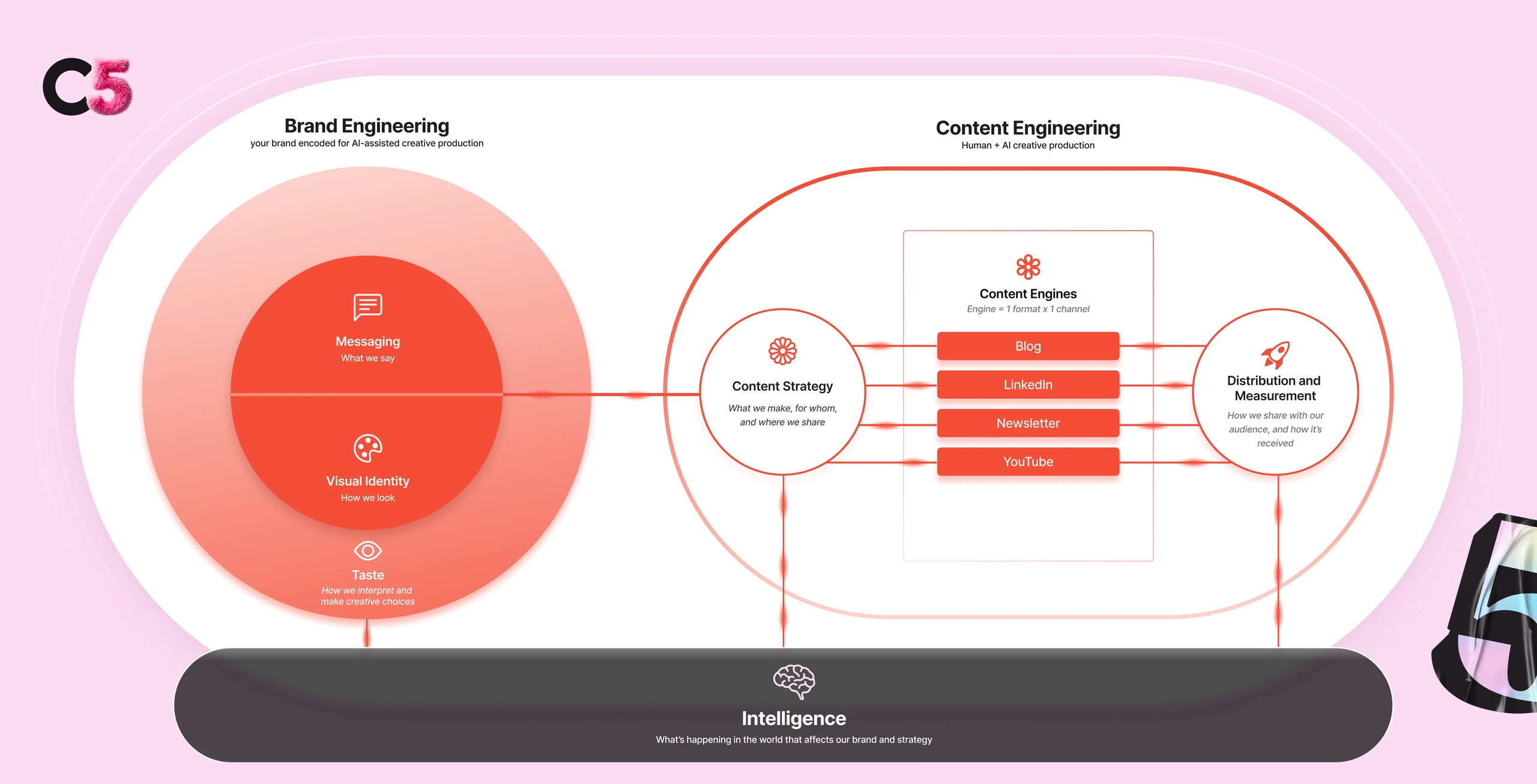
Every content system has two halves that depend on each other. The first half is brand engineering, which is your brand encoded so it’s portable to all the places your team creates today. It covers what you sound like, what you look like, and what you can credibly say. The second half is content engineering, the production layer that carries that brand onto the surfaces where work happens. It covers the how, the where, and the how often.
Content engines deliver on that portability by bringing content to life within the encoded instructions of the brand. They create content within the boundaries of the creative brief, including format and channel, applying the brand within every creative decision.
A great brand with no production layer can’t meet the brand’s marketing needs for speed and scale of content. A strong production machine with no encoded brand gets very good at making content that could belong to anyone. This is why so much content still looks and feels generic, even with all our new AI-powered abilities.
Brand engineering: your brand encoded as a portable system
Brand engineering turns your brand from a document people occasionally reference into a system of attributes and instructions that show up where you make content. A portable brand carries four things together:
- Messaging. Your vocabulary, your positioning, and your claims, so everyone knows what is approved, what is in testing, and what is off-limits. We go deep on this in our piece on the messaging layer.
- Visuals. Your design tokens, your components, and a clear set of anti-patterns, so the system encodes what’s off-brand alongside the brand.
- Taste. Representing the nuanced judgments that inform the above two components, taste is how you interpret your words and visuals and decide what does and does not feel like the brand. It is the hardest part to capture and the easiest to neglect, but it’s perhaps the most critical part because it ensures your brand’s distinction.
- Intelligence. Your claims checked against evidence, each carrying a confidence level that updates as you learn. This layer is fed by industry research as well as the signals from your content performance, so the brand keeps itself honest over time.
Of course, none of these are completely new concepts, but brand engineering puts these brand assets to work like never before. You want one source of truth, present at the moment of creation, persistent on every surface and for every person who creates in your name.
Without portability, you just have four more documents. With it, you have a brand that travels with the work. Senior brand people build and maintain this layer, since they hold the authority and taste to decide what is on-brand. That ownership is why brand engineering works as a discipline with real owners and standards.
Content engineering: putting the brand to work
If brand engineering is the brand encoded, content engineering is the brand in motion. Strategy sits at the front, the production engines sit in the middle, and distribution and measurement sit at the back.
The front: content strategy
At the front, content strategy decides why you make content at all. It also decides what you make, who it serves, and where and when it shows up. These choices govern everything downstream, because picking the wrong format or audience guarantees an efficient path to failure.
The middle: content engines
In the middle, the content engines organize production by the type of asset you make. A brand campaign, a research whitepaper, a sales pitch deck, and a search engine optimization (SEO) and answer engine optimization (AEO) blog are genuinely different machines. Each one runs its own workflow, tools, and people. Generalizing tools against the specific needs of channels and formats is where quality slowly fades.
The automation dial
Every engine runs at some ratio of human to automated work, and that ratio isn’t identical across engines. Some content, like SEO blogs, generally seeks to appeal to machines, while brand film aims to win human hearts and minds. So the real question for any engine is how much of its work you can responsibly automate, given your brand, your audience, and the content it makes. That dial is specific to your team, and it keeps moving as the tools improve.
The back: distribution and measurement
At the back end, finished assets are published and distributed. Performance and audience signals flow back into the system, together with the latest research from the wider industry. That returning intelligence updates both the brand and the strategy, which closes the loop and lets the next decision start a little smarter.
What a content system looks like in practice
Here is the flywheel we run in our content system work with IBM, a real example traced from end to end.
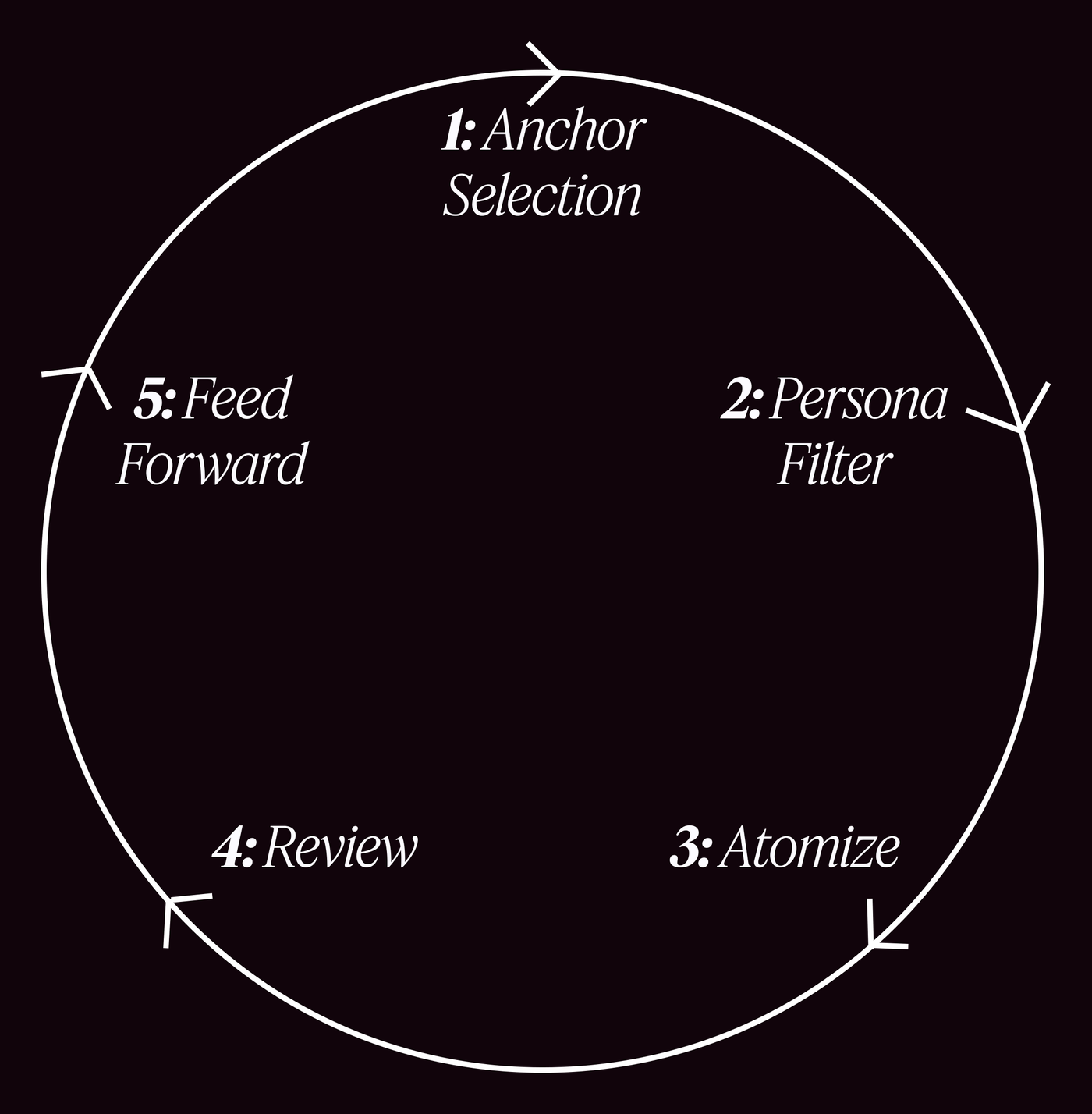
- Anchor selection. A human authors the original point of view, usually a long-form report tied to a real business question. While ideas for topics can be AI-assisted, the foundational thinking and perspective must be original and compelling. A high level of human input is important at this phase.
- Persona filter and brief. We shape that anchor for a specific audience and write the brief. It carries the brand context with it: voice and vocabulary, the visual system, the approved assets, the rules and anti-patterns, and the proof points. We encode the brand decisions before production starts.
- Atomize. From the approved brief, the system produces format-ready variants for each channel, from a couple of CTA-driven emails to a handful of short social posts, a medium blog piece, and a press blurb. Every variant carries the same angle and the same proof points. What changes is the format and the mode of resonance each one tests, whether hard data, executive narrative, or a practical checklist. The brand tokens, grid, and typography stay locked across all of them.
- Review and ship. An art director and a copy editor refine each round where it counts, and the work then clears a brand and accuracy gate before it publishes into the flywheel.
- Feed forward. Performance data from the published assets flows back into the research, and that signal shapes the next anchor we recommend.
Feedback is critical work in an engineered brand
Early in a brand engineering journey, it’s tempting to disregard first drafts as a system failure and throw the whole thing out. But remember that outputs are only as good as their inputs, and the work of continuously providing feedback to your system is critical to realizing its full benefit. This is especially true for the Taste pillar.
When the system feeds its own results into the next decision, every cycle improves the next. That kind of feedback loop separates a system that compounds from a pile of one-off campaigns. Our guide to the modern content engine breaks down a single engine in detail.
How to start before it’s finished
Most teams never build a content system for one reason: they believe they must finish it before they can use any of it. In reality, a partial system that’s actually present where work happens beats a complete one sitting in a folder nobody opens.
We recommend deploying your brand engineering early and often:
- Start with what is already true. You almost certainly have brand decisions living in people’s heads and in past work. Your first move is writing them down where the system can reach them.
- From there, grow the system in the order your drift hurts most. For many teams, that means anti-patterns first, since it is fastest to agree on what is clearly wrong.
- Then come claims with a status attached, then the core narratives, then the harder taste calls you capture as you make them.
How AI changes the picture (and how it doesn’t)
The map of a content system is generally evergreen, and technically AI-agnostic.
That is, adopting a content system simply means you have a brand and you run content programming, but it doesn’t inherently take a position on how or where to integrate AI tooling.
What AI changes is one variable underneath: how much of each part you can reasonably hand to a machine. That variable changes unevenly across the system.
Automation rises from left to right
Picture the system laid out from left to right, the way the diagram at the top of this piece lays it out. The brand sits on the left: taste, messaging, and visual identity. Strategy and the production engines sit in the middle. Distribution and measurement sit on the right.
Every brand will do things differently according to their needs, but generally automation rises as you move from left to right. Move right, toward scheduling, formatting, publishing, and pulling signals, and the work turns mechanical and repeatable, so a machine can carry more of it today. Move left, toward judgment about what the brand stands for and how it feels, and the work leans on human taste, which resists automation.
The before and after
The gradient represents AI’s potential impact.
Before, people ran the whole system, with tools assisting along the way. In the AI era, the right side compresses sharply, because repeatable work is getting faster and cheaper.
If you take this line of thinking to its logical conclusions, it points to the enduring value of brand. As distribution and assembly costs trend towards zero, what remains scarce is a point of view worth distributing.
In a way, the human core of the brand becomes your main edge.
Why the dial stays a judgment call
More than half of B2B software buyers now begin their research inside an AI chatbot, which means machines read, summarize, and repeat your content before a human ever sees it. At the same time, research on generative tools finds they pull writing toward a statistical middle. That is the drift problem from the top of this piece, now running at machine speed. Both pressures point the same way: the brands that win supply something distinctive for all that automation to carry.
This is also why you cannot set the automation dial in the abstract. The right setting depends on your brand, your audience, and the content in question, and it keeps changing as the tools do. Setting it well calls for real AI brand governance and a clear set of ethics for how AI gets used in the work, each of which deserves deliberation.
Better tools, in the form of new AI tools and existing tools’ new models, keep pushing the automatable frontier further left. With proper brand engineering in place, each new model release will nudge outputs further toward the human core, which is why the outcomes of your content engines are never static and worth consistently revisiting.
Our content system visual stays deliberately neutral on where to set the dial. Forming that point of view, model by model as the tools change, is the work of individual brand teams.
The choice every brand team now faces
All of this comes down to a choice about how you treat your brand at scale. The old instinct is to police: lock everything down in templates, route it through approvals, and hope control holds.
A content system makes a different bet: it equips the work. By encoding the brand thoroughly, it lets everyone and every tool start from the right place, so consistency becomes the default. The locked core, meaning the messaging and taste you set on purpose, is what makes open exploration safe everywhere else.
The stakes are simple: brand distinction is fragile at scale, and only a system reliably protects it, because a document cannot show up at the thousandth decision the way a system can. So every brand team now faces a choice: drift quietly toward the same middle as everyone else, or hold a point of view on purpose and build the system that carries it.
The best story still wins, and a content system is how you make sure yours is the one that gets told, consistently, everywhere your brand shows up.
Frequently asked questions
What is a content system?
A content system is the people, tools, and processes a brand uses to produce original, on-brand content reliably and at scale. It combines brand engineering, your brand encoded so it can travel, with content engineering, the strategy, production, and distribution that put it to work. Crucially, it supplies the brand at the moment of creation, so the system bakes consistency in from the start.
What is the difference between a content system and a content engine?
A content system is the whole operating model, including brand inputs, strategy, every production engine, and distribution and measurement. A content engine is one machine inside that system, usually organized around a single asset type such as a blog, a video series, or a campaign. Put simply, the system is the architecture and the engine is one of the things that runs on it. For a deeper look at one engine, see our guide to the modern content engine.
Is a content system the same as a content management system?
A content management system (CMS) is software for storing and publishing content, while a content system is the broader operating model of people, tools, and processes that a CMS plugs into. Owning the software does little for you without the system around it.
Do I need a content system if I already have brand guidelines?
Brand guidelines are one input to a content system, and a valuable one. The system makes those guidelines present in the tools and workflows where you actually make content. It also feeds results back, so the brand sharpens over time. If your guidelines live in a deck few people open while they work, you have the input without the system around it.




Let's upgrade your marketing game
Get fresh tips, how-tos, and expert marketing advice every week. (15,000 people already are.)