
Brand engineering is the practice of treating your brand identity as a living system that is present at the moment of creation, on every surface where your team works, instead of a static guideline that sits in a document. This guide explains what a portable brand system needs to contain: messaging, visuals, taste, and intelligence. It is written for brand and content leaders whose teams now deploy portable brands across AI assistants, design platforms, and coding tools that were never built to coordinate. This is the first entry in our brand engineering series.
Not but a few years ago, we were all accustomed to a creative workflow where the brand showed up after the work. Someone designed the deck, wrote the post, cut the video. And then, somewhere downstream, a (capitals for emphasis) Brand Person checked it. The review queue was annoying, but the logic held: things got made in a few known places, by a few known people, so you could stand at the exit and inspect what came through.
That arrangement is now gone. Today, your team creates in a dozen places that do not talk to each other. An AI assistant drafts the announcement. A coding tool ships the landing page. In an afternoon, a design platform produces what used to take a team and a timeline. A new hire opens a blank document and a capable model, and starts.
The first question every one of them asks, silently, is the same: how do I make this sound and look like us?
The brand drift era is born
Most of the time, the honest answer is that they guess. They paste in a color they half-remember. Or they upload last quarter’s style guide and hope the tool reads it. They write into a prompt, “make it on-brand for us,” and accept whatever comes back, because it looks plausible and the deadline is real.
The result is not a disaster. The result is fine. Technically correct.
That is exactly the problem.
Drifted by a few degrees in a hundred small ways, none of them worth stopping for, all of them adding up. Cumulative small errors become the brand.
Why brand guidelines don’t travel
When faced with brand drift, the common instinct is to blame the brand guidelines. You do not have enough of them, or they are out of date, or nobody reads them. So you commission a bigger PDF. But the guidelines are not the problem. The problem is that they do not travel. They sit in a document that opens once a quarter, in a place that is nowhere near the moment someone is actually creating. A guideline that is not present when the work happens is not governing anything. It is a record of good intentions.
The result is not a disaster. The result is fine. Technically correct.
That is exactly the problem.
Brand engineering returns us to governed brand application
The shift worth naming is the one from a brand you consult to a brand that runs with the work. Call it brand engineering: treating your identity not as a reference to be read, but as a system that is present and active at the moment of creation, on whatever surface that creation happens.
This is not a metaphor borrowed from software to sound modern. It is a description of what the job has become.
When creation is distributed across people, tools, and AI agents, the only way to stay coherent is to make the brand itself portable and operational. The brand has to be the kind of thing a tool can load, a person can lean on, and an agent can follow.
All without a human standing at the exit.
So the useful question is not “do we have brand guidelines.” Almost everyone does. The question is: what does a brand system actually need to contain so that it can travel everywhere your team creates and still hold together?
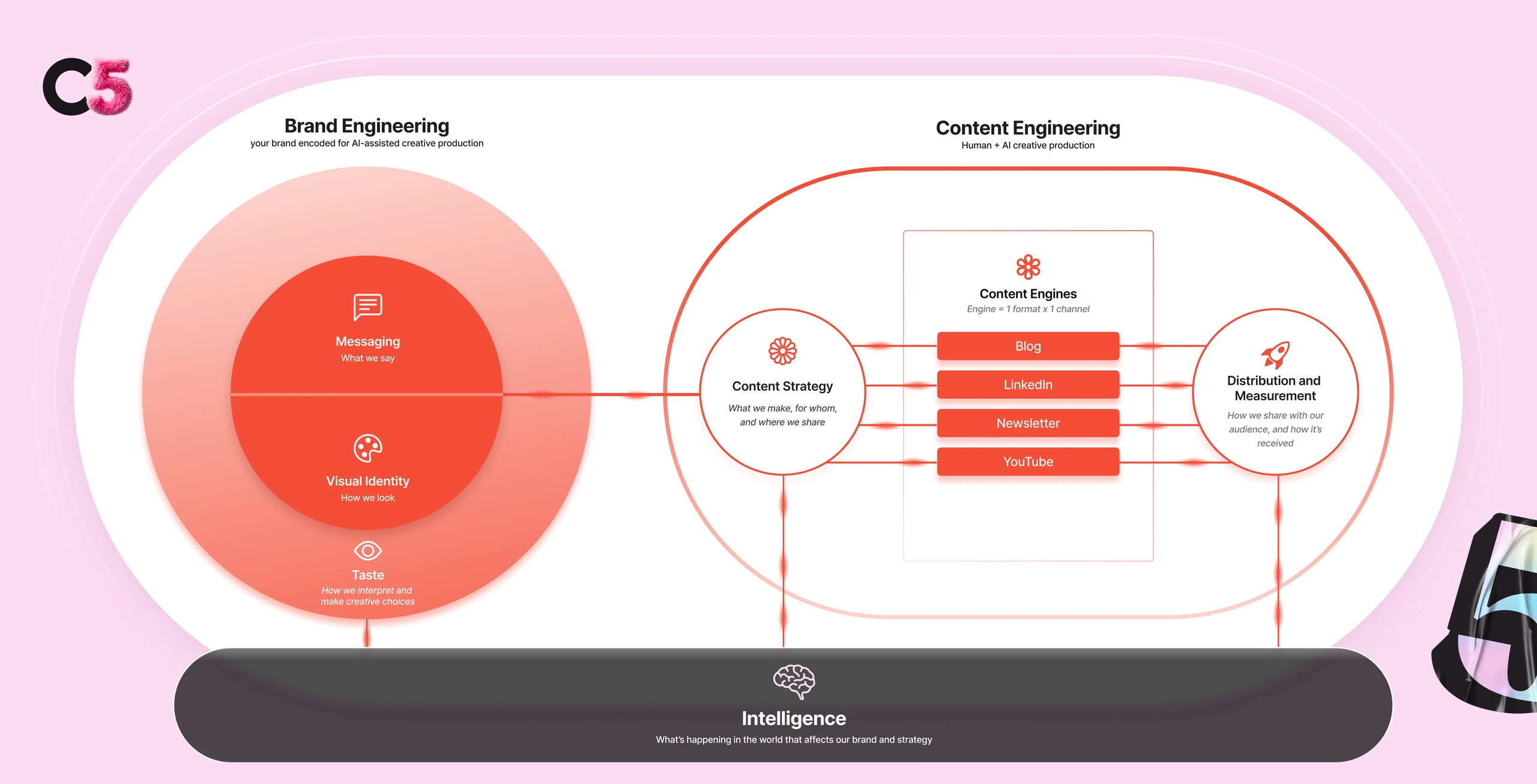
There are four things, and none of them is new. What’s new is the requirement that they travel together, as one connected system, instead of living in four different documents owned by four different people.
1. Messaging: what you say and what you can claim
Messaging is what you say and, just as importantly, what you are allowed to claim.
Most teams have some version of this. A tone of voice paragraph. Some words they like. A boilerplate. But voice notes do not survive contact with an AI tool, because the tool has no anchor. Ask any capable model to write “in your voice” and it will regress to the mean of your category. It will reach for “unlock your potential” because nothing told it not to. It will invent a statistic because the sentence had a rhythm-shaped hole in it.
When creation is distributed across people, tools, and AI agents, the only way to stay coherent is to make the brand itself portable and operational.
A messaging layer that can travel needs more than a vibe. It needs the actual vocabulary you use and the words you refuse. It needs your core narratives written down as canonical text, not paraphrased fresh every time. And it needs your claims to carry a status: which ones are proven and can be stated plainly, which ones need hedging, which ones are not yet earned and must not appear at all. A claim with no status attached is a claim someone in a hurry will overstate.
The point is not to script every sentence; it is to make the brand’s actual language available at the moment of writing, so the work starts from your voice instead of arriving at the category’s.
2. Visuals: tokens are the floor, not the system
Visuals are the obvious half, and the half most teams over-index on. Colors, typography, spacing, logo. The tokens.
Tokens are the floor, not the system. A modern AI tool can read a hex code and a font name perfectly well. What it cannot infer is everything around the token: that this orange is for emphasis and never for a background fill, that body copy is never centered, that you do not use drop shadows or stock photography, that a particular layout is yours and a particular one is forbidden.
Those constraints, the things you never do, are doing more work than the things you do. They are the difference between a tool that produces your brand and a tool that produces a competent average of your category with your colors painted on. A visual system that travels has to carry its anti-patterns as hard constraints, not as footnotes. The rules that protect the brand are as important as the assets that express it.
3. Taste: judgment, written down
Here is the one most systems leave out, because it feels unsystematizable. Taste is what makes the output yours rather than merely correct.
This matters more now than it ever did, for a specific reason: correct is no longer scarce. Any competent model can produce on-brand-enough work all day. It will get the colors right and the grammar right and the structure right. Correct is the new baseline, and a baseline is not a brand. Distinctive is the thing you have to encode on purpose, because nothing produces it by default.
Taste sounds like magic, but in practice it is just judgment someone has written down. It is the accumulated set of small calls your best people make without thinking: this illustration approach, not that one. This kind of opening line. That texture. This thing we tried that felt slightly off and agreed never to do again. Left in people’s heads, that judgment does not travel and does not survive turnover. Captured, even roughly, it becomes part of the system. Every correction is a taste decision you can keep.
You do not need a philosophy of taste to start. You need to start noticing the calls you already make, and writing them where the tools can reach them.
4. Intelligence: the system that learns
The last piece is what keeps the system from going stale: it should learn.
A static brand system is correct on the day it ships and slightly less correct every day after. An intelligent one closes the loop. Claims get validated against evidence and assigned a confidence level, and that level changes as the evidence does. You assess content against the system, not just admire it. What performs feeds back into what you emphasize next. The brand gets sharper through use, not through another offsite and another revision cycle.
This matters more as buyers meet your brand through AI as much as through your own channels. More than half of B2B software buyers now begin their research inside an AI chatbot rather than a search engine, which means an incoherent brand does not just look inconsistent. It gets left out of the answer entirely.
This is the part that turns a brand system from a cost you maintain into an asset that compounds. Consistency is not the ceiling. It is the precondition for getting better on purpose, because you cannot improve a thing that drifts randomly.
The brand gets sharper through use, not through another offsite and another revision cycle.
Portability: the property that makes the four count
You can have all four of these and still gain nothing, if they live in four separate places that none of your tools can reach. The four pillars are necessary. Portability is what makes them count.
Portability means the brand travels with you wherever you create. Not as a link to a document somebody has to remember to open, but as structured information that loads directly into the tools your team already uses: the AI assistant, the design platform, the coding environment, the doc. One source of truth, present at the moment of creation, the same on every surface, and current because it updates in one place instead of fragmenting into stale copies.
This is the difference between a brand that is described somewhere and a brand that is available everywhere. Described brands drift, because description is passive and creation is constant. Available brands hold, because the depth is on hand exactly when someone reaches for it. The goal is not to put a guideline in front of people after they have made something. It is to put the brand inside the work while they are making it.
You don’t need it finished to start
Here is where most brand-system efforts die: the belief that you have to finish before you can begin. Teams imagine they need the complete visual system, the full messaging architecture, the proof points, the taste library, all of it, before any of it is worth deploying. So they scope a six-month project, and the project becomes a document, and the document does not travel, and you are back where you started with: a heavier PDF.
A good system is honest about fidelity, not judgmental about completeness. Start with what is already true. A logo, a few colors, one typeface, a sentence about how you sound. That compiles into a real, even if partial, system, with its gaps clearly declared. It is immediately more useful than nothing, because it is present where the work happens instead of perfect and absent.
Then it grows in the order that matches your pressure. Add the constraints, the things you never do, because that is where drift hurts first. Add your core claims with their status. Then the narratives. Add the taste calls as you make them. Each layer makes the next output a little more yours. None of them has to wait on the others. The system that gets adopted is the one that started small and traveled, not the one that aimed for complete and stayed in a folder.
Starting imperfect is not a compromise. It is the only version that actually ships.
Equip, don’t police
The last fear worth naming is that all of this is a leash—that encoding the brand is a way to contain the team, automate the review queue, and turn creative people into rule-followers. We’ve seen some of our clients get frustrated with internal brand teams who functioned more like brand police because of effects like this. If that were what a brand system did, it would deserve the resistance it gets.
The aim, quite frankly, is the opposite. The reason to make the brand portable and present is to stop policing output and start equipping creation. A small, clear set of things are genuinely locked: the anti-patterns you never violate, the claims you cannot make without proof, the few decisions that require a human to weigh in. Everything else is open. The system is not there to approve your work after the fact. It is there to put the full depth of the brand in your hands while you do the work, so that staying on-brand is the path of least resistance instead of a gate at the end.
Good brand engineering changes the brand team’s job for the better. Instead of standing at the exit inspecting output, they architect the system that makes good output the default, and they spend their attention on the small set of decisions that actually need judgment. The team creating gets the brand’s depth on tap and the freedom to explore on top of a foundation that holds. Official brand and open exploration stop being in tension. The locked core is exactly what makes the exploration safe.
Make your brand travel with the work
A brand worth protecting has to survive new tools, new hires, agency partners, AI agents, and a dozen work streams that will never coordinate on their own. It cannot do that as a document. It can do it as a system: messaging, visuals, taste, and intelligence, made portable, present at the moment of creation, and honest about where it still has room to grow.
The reason to make the brand portable and present is to stop policing output and start equipping creation.
We’re building that system with Brandcode (working title). But the idea matters more than the product, and it is true whether you build it with us or not. Start where you are. Encode what matters most. Make it travel. Let it get sharper through use. Your brand should be with you wherever you create, and it does not have to be finished to start being useful.
This is the first piece in our Brand Engineering series. Next, we go deeper on each layer, beginning with why correct stopped being enough.
Frequently asked questions
What is a brand engineer?
A brand engineer builds the system that produces consistent brand output regardless of who, or what tool, is doing the work. Where a brand strategist defines meaning, positioning, and direction, a brand engineer turns those decisions into structured, machine-readable rules and constraints that travel into the tools where work actually happens, so staying on-brand becomes the default rather than a final review.
How is brand engineering different from brand guidelines?
Brand guidelines are a document you consult; brand engineering is a system that runs with the work. Guidelines describe the brand in one place that opens occasionally, usually far from where the work is being made. A brand engineering system makes the brand present at the moment of creation, on every surface, and keeps it current because it updates in one place. If you are still standardizing the basics, a cohesive corporate identity is the raw material a brand engineering system makes portable.
Is brand engineering the same as a design system?
No. A design system covers the visual layer: tokens, components, and usage rules. Brand engineering is broader. It treats messaging, visuals, taste, and intelligence as one connected, portable system, where a design system is roughly one of the four components. The visual tokens are the floor, not the whole brand.
Where do you start with brand engineering?
Start with what is already true: a logo, a few colors, one typeface, a sentence about how you sound, and the hard constraints you never violate. That partial system, present where the work happens, is immediately more useful than a complete one that stays in a folder. Then add your claims with their status, your core narratives, and your taste calls as you make them.




Let's upgrade your marketing game
Get fresh tips, how-tos, and expert marketing advice every week. (15,000 people already are.)