On April 17, 2026, Anthropic released Claude Design, putting median-good visual production within reach of anyone with a chat window. This is Column Five’s candid read on what that shift means for brand teams: why the brand system becomes the most leveraged asset a company owns, why governance has to move to the moment of creation, and why expert judgment matters more in this environment, not less.
Anthropic released Claude Design in research preview last week, and we have been testing it heavily ever since. Our candid read: this is the ChatGPT moment for the world of visual marketing, and the brand teams that move first on it will have a real advantage. The pressure that lands hardest is on the brand system itself, which is why we are writing this now.
When ChatGPT arrived, median good writing became accessible to everyone. The consequence was not the end of writing. It was a quieter, more uncomfortable shift. The floor of written content rose, and the ceiling of what readers were willing to ignore rose along with it. A great deal of writing became easier to produce and easier to scroll past at the same time.
The ChatGPT moment, now for design work
Claude Design does the same thing for visual marketing. Someone who has never opened a design tool can now generate a coherent, on-brand presentation, one-sheet, landing page prototype, or PDF in an afternoon. The output is genuinely impressive. We are not going to sugarcoat what that means. Our production workflow is changing, and we are changing with it.
We would rather be honest about that than defensive. Some of what our industry has historically charged for is now available inside a chat window. A company can load its brand guideline PDF, its website, and its local files, and watch a usable design system appear. That is a real shift. Pretending otherwise would be a worse service to our clients than telling the truth about it.
So here is what we think is actually true, and where we are putting our effort.
Median good is now the floor, not the ceiling
When production speed levels up across every industry at once, the work that stands out is the work with the clearest point of view underneath it. These tools multiply whatever you feed them. A strong brand, a sharp messaging layer, and a real perspective produce work that feels alive and distinct. Generic inputs produce generic outputs at impressive speed. The bar for “passable” just moved, and so did the bar for memorable.
The brand system is now the most leveraged asset a company owns
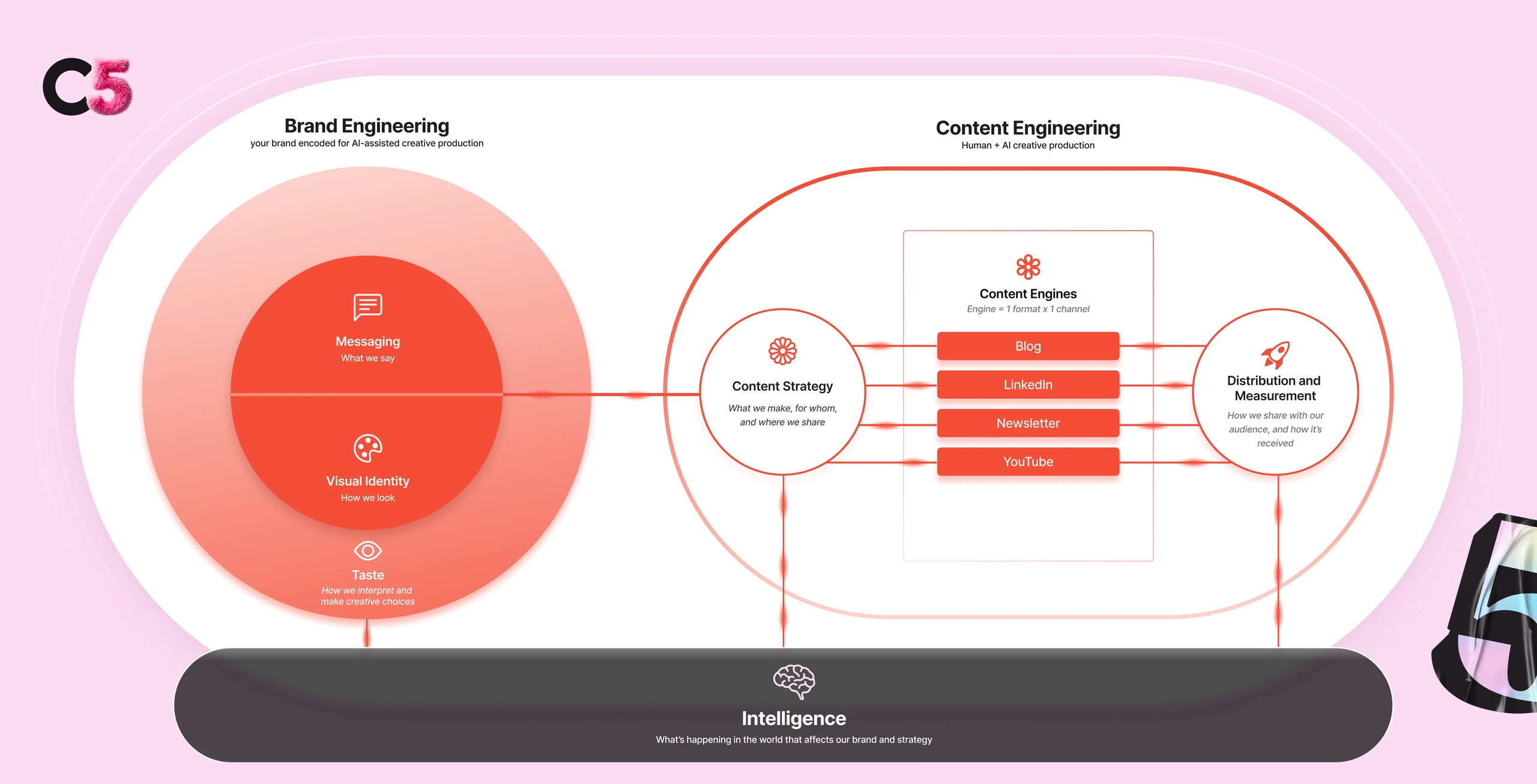
Claude Design infers a visual system from what you give it. If your brand is a PDF from 2021 with three logos and a color palette, the output will reflect that. If your brand system includes a real story, a distinct visual language, a messaging architecture, and the kind of structured brand asset library our team has spent nearly two decades building for growth-stage and enterprise clients, the output starts to sound and look like you. That difference is the difference between scale and noise.
Governance has to move to the moment of creation
Historically, brand governance lived in a review queue at the end of a process. Designers made work. Brand leads approved or sent it back. In a world where a product manager, a sales lead, or a marketer can generate a presentation in your brand in fifteen minutes, that model stops working. The structure of the brand system itself is now the guardrail. If the system is right, the output is usable. If the system is thin, the system will be exposed instantly and at volume.
Expert eyes still matter, and probably matter more
Every time we make something in Claude Design, our first instinct is the same. We want an art director or a designer to look at it. The tool is not failing us. We simply hold higher standards than median good, and publication-ready work still requires judgment the tool does not have. Strategy, storytelling, additive illustration, and design thinking do not become obsolete in this environment. They become the thing that separates work people actually care about from work they scroll past. If you want a fuller view of how we think about AI’s role across marketing, we have written about that separately.
We are using this moment to disrupt ourselves
That is the point we most want our clients to hear. We are not fearful about this, and we are not ignoring it. We are leaning in, building real fluency, and we would rather share what we are learning than protect old workflows.
Here is what that looks like in practice right now. We are loading client brands into Claude Design and setting up their design systems the way we would set them up in any other production environment. Our team is testing what the tool can and cannot do across presentation design, motion, web prototypes, and PDFs. Along the way, we are finding the seams, the places where it needs a human hand, and the places where it saves whole days.
What we would like to do with you
If you are a client, we would like to set up your brand system inside Claude Design and workshop it with your team. We can load your guidelines, your assets, and your messaging architecture. We can show you what the tool handles well, where it falls short of your standards, and how to operate it without diluting what makes your brand yours. Nearly two decades of building brand systems for growth-stage and enterprise companies has given us a clear sense of the standards this work has to meet. We would like to bring that to this new environment with you.
If you are not a client, and this conversation is of interest, we are opening a small number of fifteen-minute sessions to compare notes. The goal is not a pitch. The goal is to be useful to you in a moment that is moving faster than any of us anticipated.
This is a real shift. We are optimistic about it, and we are building for it. We would rather be in the room with you, figuring it out together, than watch it happen from the sidelines.
Grab 15 minutes to workshop your brand system inside Claude Design →




Let's upgrade your marketing game
Get fresh tips, how-tos, and expert marketing advice every week. (15,000 people already are.)