Brand consistency used to mean following the guidelines: the right colors, the approved fonts, the sanctioned voice. Now that AI can hit all of those on the first try, consistency alone no longer sets a brand apart. What separates distinctive work from merely correct work is taste, the judgment that decides which on-brand options are actually good. This article, the third in our brand engineering series, explains what brand taste is, why AI-generated work so often feels generic, and how to encode your taste so it compounds instead of fading.
You can load every brand guideline you own into an AI tool, write a careful brief, and get back work that passes every check while still making your best designer wince. Everything technically works: the colors are accurate, the voice is close, the claim is sound. And yet the result still feels like it could have come from anyone.
That wince is your brand taste showing up. The feeling is unequivocal, and it marks the distance between work that is merely acceptable and work that is genuinely yours.
The problem? It is almost never written down anywhere.
Failure to document brand taste may be the single biggest contributor to brand drift for marketing orgs that are trying to scale their creative.
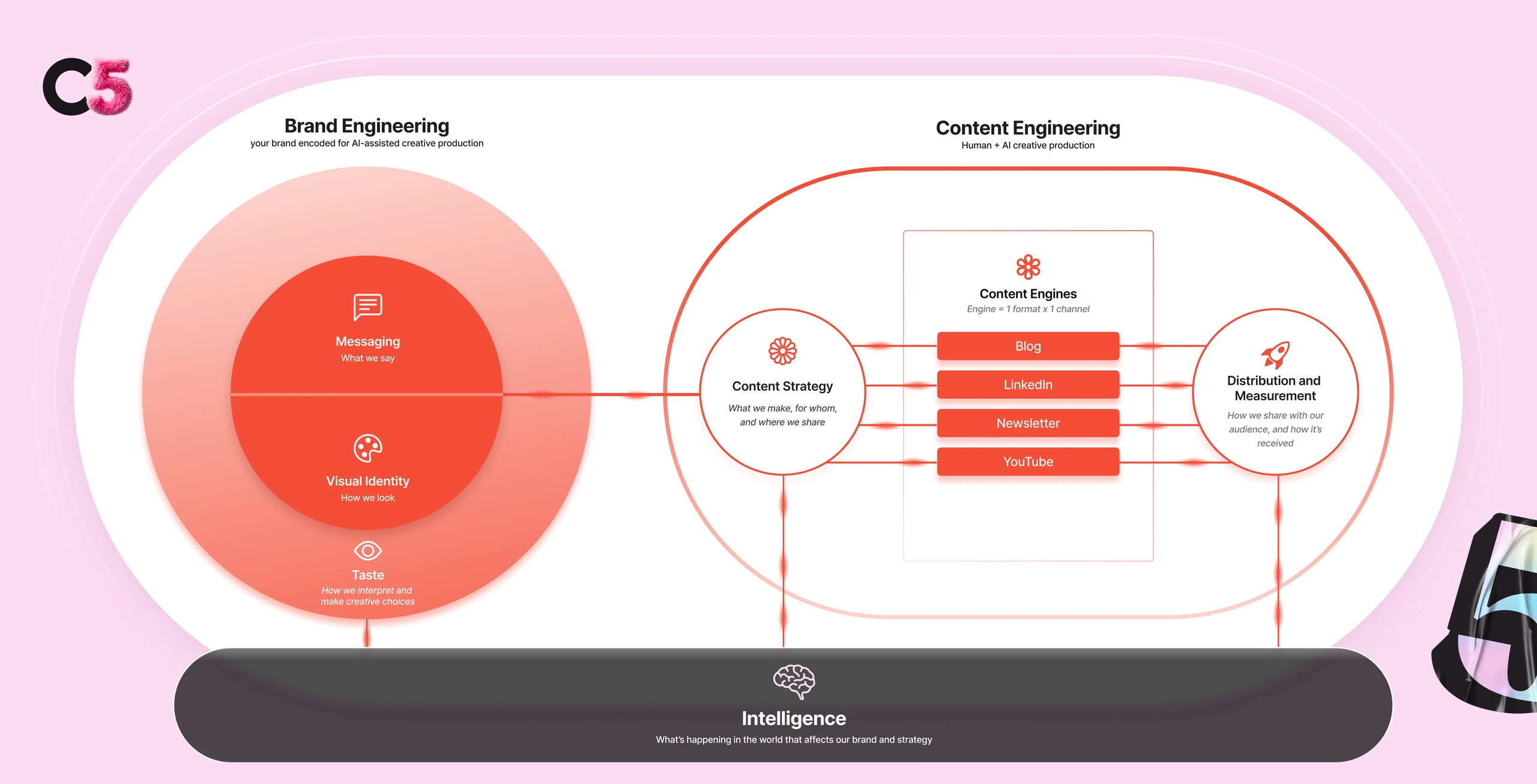
Our first article on brand engineering placed taste alongside messaging, visuals, and intelligence as one of the four parts of a portable brand system. The messaging layer records what your brand can say, and your visual system records how it looks.
Encoded taste governs something harder to pin down: how a brand chooses among all the executions those rules already allow.
What is brand taste?
Brand taste is disciplined judgment about which creative choice fits a particular brand, audience, and moment. People often mistake it for the creative director’s personal eye, or for some abstract, universal good taste, but it is really a bet about a specific audience, made in a way that is unmistakably you.
Keeping both halves of that bet front of mind—brand and audience—is critical. When you drop the audience from the picture, taste curdles into self-indulgence, and you make work your team admires while the market ignores it. On the other hand, when you build without regard for the brand, you drift into pandering, chasing whatever is popular and ending up with work no one can trace back to you.
Good taste lives in the narrow band between those two failures, rooted in who you are and calibrated to who you are for.
This is also why taste cannot be copy-catted. A move that is perfect for one brand can be wrong for another, simply because the two are reaching different people, in different contexts, with a different story to tell. So the useful question in any review is always the same one: is this good for our people, coming from us?
Why does on-brand AI content still feel generic?
Conventional brand guidelines only capture what is correct, and correct is exactly what technically-right-but-generic looks like. A brand system encoded in Claude, or any other model, can give you accurate colors and close-enough voice on the first pass, which is genuinely useful for scaling content creation.
But accuracy is now the floor, available to everyone, and a floor does not differentiate you from anyone.
More than ever, in the AI era distinctiveness is king. It’s accomplished via the judgment calls that guidelines leave out: the specific rejections, the hard-won exemplars, and the reasoning behind them. That judgment is the part a competitor cannot reproduce by feeding your public guidelines into a model, because it was never in the guidelines to begin with.
It lives instead in the thousands of small calls your team has made over the years and, in most cases, never recorded.
How creative reviews reveal your brand’s taste
We’ll venture to guess that most of your brand’s taste is already being produced out loud, in a place you are probably not routinely capturing it: the creative review. Every time someone says “this is close, but…” a taste decision is being made. That sentence is a piece of your brand’s judgment surfacing in real time, and if you write it down, you never have to relitigate it. But, if you leave it in the room, you will make the same call again next month from scratch.
We saw this pattern clearly in an audit of our own generative production history at Column Five. Earlier this year, we reviewed Art Director feedback on 105 images produced over dozens of feedback conversations.
Many of the images were rejected for the same nuanced reason: it was reading as stock imagery because of the crude way the engine was dropping photographic images onto a brand color background. Instead, the foreground needed to leverage a brand accent color.
Once we encoded that problem pattern along with its solution and reasoning, it stopped being a recurring argument and became guidance a new designer, or an AI tool, could actually follow. Critically, we saved a positive and negative example to help the system learn from it.
The record looked like this:
- The call: put visible brand accent on the illustration subject when the background is dark or neutral.
- A positive example: work where the palette changes the object itself.
- A negative example: a naturalistic object that reads like stock.
- The reason: background color alone does little to make a subject recognizably Column Five.
- The scope: Column Five illustration on dark or neutral backgrounds.
- The owner: the illustration-system owner, who promoted it after three documented occurrences.
The rejected work matters as much as the keepers, because a clear “never” is what defines the boundary. In the same list of nevers, we outlawed ghosted background text, as well as fossils and seashells imagery.
How a taste call earns authority
Of course, a strong reaction in one review should not instantly become law for the whole brand. Healthy brand memory needs states, so that a call can be useful without being binding until it has earned its way up.
The path looks roughly like this:
- A call starts as an observation, one documented reaction with its reasoning.
- It becomes a candidate when the same direction shows up again and someone puts it on a shelf to watch.
- It earns surface approval once it holds across a few relevant reviews inside a specific channel or format.
- And it becomes canon only when it has proven out across campaigns and carries enough evidence to govern recurring work everywhere.
We use a simple starting table for who can promote what, and any team can tune it to its own tolerance for risk:
| State | What it takes | Who promotes it |
|---|---|---|
| Observation | One documented call with its reasoning and scope | The reviewer, kept local to that asset |
| Candidate | The observation plus its nearest positive and negative example | The named surface owner accepts it onto the shelf |
| Surface-approved | The same call in three relevant reviews, with conflicts resolved or noted | The channel or format owner, who sets an expiry date |
| Canon | Evidence across at least two campaigns, plus a second kind of evidence for any claim about effectiveness | The brand owner or governance group, who sets a review date |
A reversible social post can move up this ladder quickly, while a rule that governs your flagship identity or a public claim should earn its authority slowly. The reason to keep these states separate is that memory and canon do different jobs. Your memory can hold everything that happened, including the disagreements and the experiments that went nowhere, while canon governs only the handful of choices you actually want to repeat. Keeping them apart lets a brand stay honest about its own history without turning every past success into a permanent rule.
Trend vs. shift: which signals should change your taste
Once your taste can evolve, you need a filter for what should move it, because most of what looks like a reason to change is really just noise. The distinction that matters here is between a trend and a shift.
A trend is a ripple: fast, surface-level, and usually a little embarrassing six months later. It is the format everyone suddenly adopts, the filter, the meme structure that is already fading by the time most brands notice it.
A shift, by contrast, is structural. It is a real change in how your audience finds, trusts, and judges things, like discovery moving into AI answers or a channel quietly losing its place in the buying process. The move that pays off is to respond to shifts and only sample trends at the edges, because by the time a trend is obvious enough to chase, the people who set it have already moved on.
This gets sharper at the resolution where brands actually reach people. In practice you are never really reaching “the culture” in the abstract. You are reaching specific people inside microcultures and algorithm bubbles that move faster than broad culture and carry much sharper radar for outsiders. Work that reads as fluent from a genuine participant reads as costume from a tourist, and tight communities can spot a tourist instantly. What matters is fluency rather than trend coverage, and presence in those spaces has to be earned before you can spend it.
How to scale taste without scaling sameness
Scaling taste is about repeating a way of choosing rather than a fixed look. Repeating a single visual treatment gives you consistency, while repeating a decision process supports a much wider range of coherent work.
Evan Armstrong’s reporting on MSCHF is a useful case here. In “The Art of Scaling Taste,” he describes a team of 34 people that released more than 100 products over five years, roughly one every two weeks, across wildly unrelated formats, while holding onto a recognizable point of view throughout. What held it together was the decision architecture, meaning who contributes ideas, who decides, which ideas get time, and how the team balances artistic ambition against commercial reality. The coherence lived in how the choices were made rather than in any fixed style.
This is also where encoded taste can quietly backfire. If you only capture the winners, you build a library of approved examples that invites imitation, and imitation is how you end up encoding sameness. Decision records avoid that trap because they preserve the reasoning, the boundaries, and the rejected alternatives, which is exactly what a future team needs to extend your judgment into a situation you never anticipated. So the habit worth building is to capture judgment liberally and promote it cautiously.
AI raises the stakes on this in a specific way. Generative tools can genuinely expand what a team explores, but they can also pull a group’s output toward the average. In a controlled study published in Science Advances, Anil Doshi and Oliver Hauser found that giving writers access to generative AI improved individual stories, especially for less creative writers, while making the whole set of stories more similar to one another. That is the pattern to design against: more individually competent work that collectively looks the same.
Your taste system actively protects the differentiation that AI quietly erodes.
Start with one decision per review
None of this requires a governance project to get going. It starts as a habit: end each review by writing down one decision, with enough context that someone else could apply it well. We recommend capturing five things for each call:
- The call. State what you selected, rejected, or refined, in plain language.
- Both sides. Include one positive example and the nearest rejected alternative.
- The reason. Name the audience, brand, craft, or business thinking behind it.
- The scope. Say where it applies: which campaign, channel, format, or audience.
- The owner and revisit trigger. Name who can approve it as guidance, and what change or date should reopen it.
Keep new calls on a candidate shelf until repetition or evidence earns them wider use, and review that shelf on a cadence that fits how fast your brand moves. For most teams, a quarterly pass works well: promote the patterns that keep proving true, preserve the useful alternatives, and retire the rules that have quietly stopped being true. A taste system that only ever adds rules is slowly calcifying, while one that also retires them stays alive.
Why taste is the ultimate unlock
Taste is the hardest part of a brand to encode, and for the same reason it is the most valuable. It cannot be downloaded. A competitor can read your messaging and study your visual system, but they cannot copy the accumulated judgment of a brand that has made ten thousand small decisions and kept a record of the ones worth repeating. That accumulation compounds, growing sharper and more defensible the longer you run it, even as everything that can be loaded straight from a guideline keeps getting more commoditized.
This is the part of the system we have spent the most time building inside Brandcode, because it is what decides whether all the encoding underneath it produces work that is merely correct or work that is unmistakably yours. Real brand consistency, at its most valuable, is the discipline of repeating the judgment that makes your work recognizable, and letting it sharpen over time.
Taste tells you what is worth repeating. The last piece in this series, intelligence, asks the question taste cannot answer on its own: once you have made the distinctive thing, did the market actually receive it? That is where we go next.
Frequently Asked Questions
What is brand taste?
Brand taste is disciplined judgment about which creative choice fits a specific brand, audience, and moment: what to select, reject, refine, and repeat. It goes beyond brand guidelines, which define what is technically correct, to decide which of the many correct options are actually good for your audience and recognizably yours.
Why does AI-generated content feel generic even when it follows brand guidelines?
Because guidelines only capture the rules, and generic is what technically correct work looks like without judgment. Distinctive output needs the taste that sits on top of the rules: the rejections, the exemplars, and the reasoning that tell a tool what is allowed and, beyond that, what is genuinely yours.
How is brand taste different from brand consistency?
Brand consistency is repetition over time, and on its own it can just as easily repeat something average. Brand taste is the judgment that decides what is worth repeating in the first place. Encoding your taste is how brand consistency becomes distinction instead of sameness.
Can brand taste actually be encoded?
Most of it can. Taste shows up as specific, repeatable judgment calls, and those can be recorded as preferences, anti-patterns, annotated examples, and the reasoning behind them. What you cannot fully capture is the faculty itself, which is why the goal is to encode the recurring calls so human judgment stays free for the genuinely new ones.
How often should brand taste change?
At two speeds. The core should evolve slowly, in response to structural shifts in how your audience finds and trusts things, while the edges can experiment quickly and cheaply. It is better to sample trends than to adopt them as identity, and to retire rules once they stop being true, so the system stays current instead of calcifying.



Let's upgrade your marketing game
Get fresh tips, how-tos, and expert marketing advice every week. (15,000 people already are.)