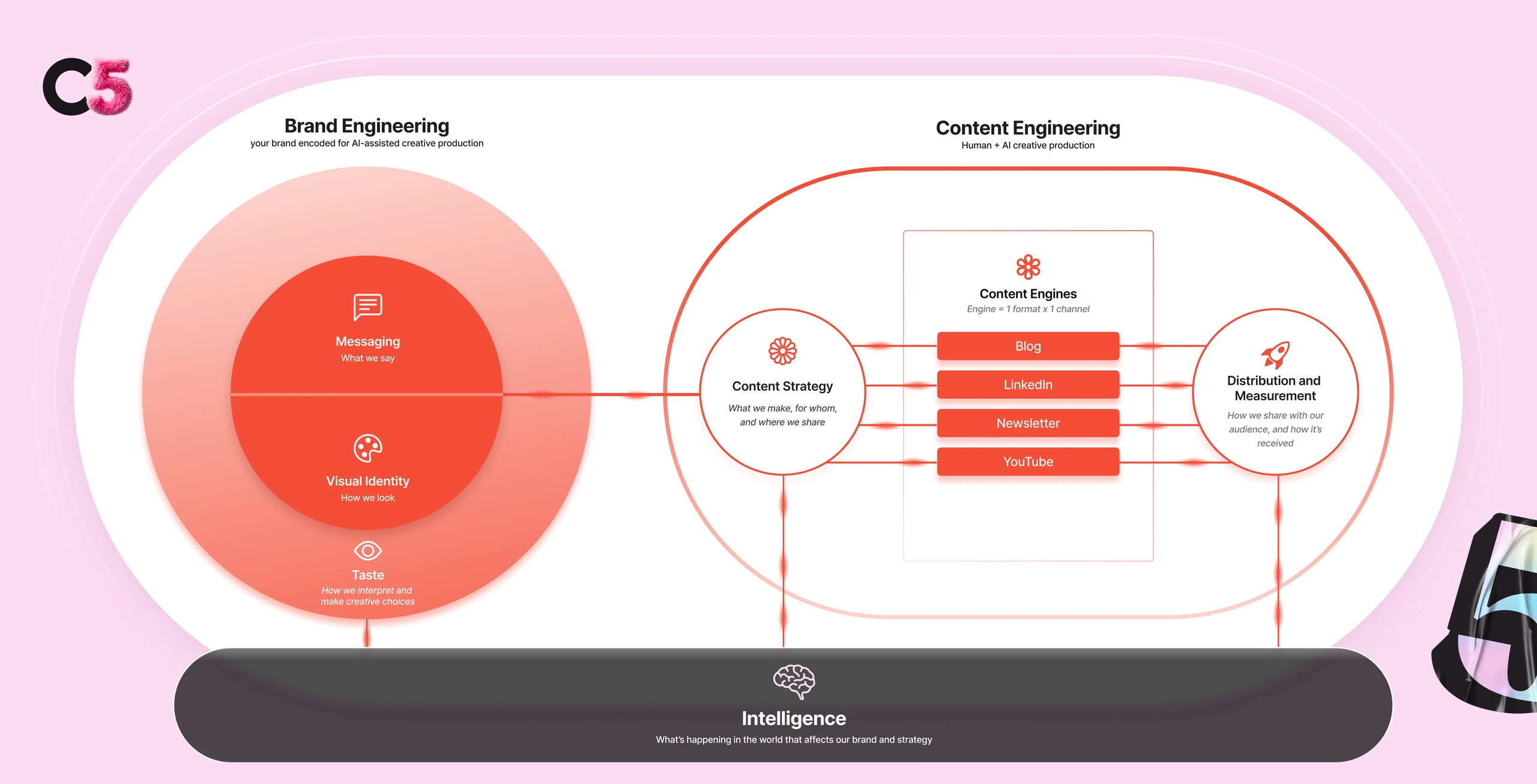

Your brand messaging probably lives in a document nobody opens at the moment content actually gets made. This guide explains the messaging layer, the part of an encoded brand that governs what you say: the five things worth encoding, where the layer should live, and how to keep your team and your AI tools on-message. It is the first installment in Column Five’s brand engineering series.
A messaging layer that only flows one direction is a style guide. One that flows both ways is alive.
Somewhere in your company, a document defines your brand essence. It probably covers your brand truth and brand promise too. It likely adds your pillars, your big idea, your platform, and a pyramid or house or wheel to hold them all together.
Now try a quick test. Open the last five things your team shipped, say a landing page, a sales deck, two social posts, and an email. Then ask which line in any of them actually came from that document. For most teams, the honest answer is none. The strategy deck did its job in the meeting where it got approved. After that, whoever happened to be writing that day made the real words up fresh, asset by asset. So the messaging exists on paper, yet it never quite shows up in the work.
That gap used to be survivable. Production was slow enough that a few good writers could hold the message in their heads and keep everything roughly aligned. AI production erases that buffer. Now anyone on the team can generate a polished draft in a minute, using tools that have never read your strategy. Those tools would not know what to do with a brand pyramid if you handed them one. So your message either shows up at the moment of creation, or it does not show up at all.
This piece is about the messaging layer, the part of an encoded brand that governs what you say. It’s the right place to begin, because words are where most brands drift first and notice last.
The five things worth encoding in your messaging system
This is the point where an article about messaging usually starts selling you a framework, but we are going to skip that. You already have one, or enough of one, and arguing about whether a line is a brand promise or a brand truth is exactly the kind of debate that keeps messaging trapped in a document.
The useful question for an engineered brand is not what belongs in your framework. It is which parts are worth encoding so the rest of your system can use them.
When we evaluate a brand’s story, we look at five things. We call them the five P’s.
- Point of View. Are you saying something only you can say, and does it hold together across everything you publish?
- Positioning. Is it clear what you do, who it is for, and what problem you solve? Your value proposition lives here, as part of positioning, not as a separate orphaned artifact.
- Proof. Can you back it up, for every kind of buyer, at every stage? Named customers, specific outcomes, evidence that is still current.
- Personality. Would someone recognize your brand from the writing alone, with the logo taken off?
- Public Perception. Does the market actually recognize (and repeat) what you claim?
Point of View, Positioning, Proof, and Personality are things you decide and write down. They are the inputs every piece of content draws from, which is exactly why they belong in an encoded messaging layer.
Words are where most brands drift first and notice last.
You may have noticed one of these P’s is not like the other.
Public Perception is a different animal. You do not get to write it. You learn it, and in some cases you can influence it. For the purposes of a messaging system, the most valuable thing you can do with a reputation is measure it and feed what you learn back in with the other four. Doing so can help your generative tools serve you better, for instance by understanding which claims are instantly credible and which require a more measured approach.
That is the whole inventory for an encoded messaging system. If a component of your current framework does not feed one of those five, you can certainly include it—just make sure you surround it with the context to make it useful.
Engineered messaging is more self-aware
Here is where a well-engineered brand departs from a well-organized strategy deck. In most companies a message is a sentence in a document, and everything else about it lives in people’s heads.
The portability of that sentence in that document is dubious. People who come across it are left to wonder: Is it still current? Is the exact wording sacred, or can it be adapted? Does it belong in a sales deck or only on the blog?
You write the sentence down. The knowledge about the sentence stays tribal, and tribal knowledge does not survive a freelancer, a new hire, or a generative tool that has never met your team.
What do we mean by “encoding?”
Encoding just means writing the knowledge down with the sentence, thereby converting it from tribal to institutional. For example, take a phrase that we at C5 treat as canon: “consistency compounds.”
When encoded, it’s not just the words at face value. Suddenly the messaging system expands to become the words plus the things someone would otherwise have to ask. These take the form of rules, such as:
- Use this one verbatim
- It can appear anywhere from the homepage to a sales email
- It needs no hedging
- It is current as of this quarter
Encoding is simpler than it may sound: it starts as a few plain lines, written once. A claim that is still maturing as it’s tested in marketing and sales may include an honest note that it needs qualifying language until the evidence catches up. Multiply that by the thirty or forty messages a brand actually runs on and you have something a deck can never be: a source of truth that answers questions at the moment of making, instead of after, in a review.
Tip: make a habit of recording your content reviews so you can have AI tools analyze the creative discussions in the transcript and suggest implications for your encoded messaging.
Where does the messaging layer actually live?
A fair thing to ask at this point is: where do I do this? The messaging layer lives as a small set of source-of-truth files, kept wherever the people and the tools that make your content can both read them.
For many teams that starts as a shared, structured workspace sitting next to the brand assets you already keep. For teams further along, it is a versioned repository your AI tools connect to directly, so the same source updates everywhere at once. The format matters less than the principle: one place, readable by humans and machines, that is the canonical answer.
Concretely, gather four things and write each one down in plain language:
- your point of view, on a single page
- your positioning, with the value proposition stated inside it
- your claims, each one paired with the evidence that backs it and a note on how current that evidence is
- your voice, described well enough that someone who has never met your team could write a sentence that sounds like you
Then add the most useful artifact of all, and the one people skip: a shipped piece. A shipped piece is simply something you have already published that gets it right. You point at it and say, like this. One real, annotated example steers output, human or machine, more than any number of adjectives about tone. Gather one for each major thing you make: a blog post that nails the voice, a sales page that lands the positioning, a case study that shows what good proof looks like.
The messaging layer lives as a small set of source-of-truth files, kept wherever the people and the tools that make your content can both read them.
That is the whole material list. Point of view, positioning, claims with proof, voice, and a few real examples, all in one readable place.
When your workflow calls on it
It’s not until you integrate the messaging into your workflows that this all begins to create impact. Decide the one step in your content process where the messaging layer gets pulled in, and make that step early. Ideally, this should happen during the creation of the first draft, if not earlier. The most common failure is treating messaging as a checklist at the end, something a reviewer runs against finished work. By then the thing is already made, and you have demoted your source of truth to a list of corrections.
Implement your messaging at the front and it becomes what it was always supposed to be: the brief the maker starts from, whether that maker is a writer on your team or a tool you have pointed at your repository.
Each content format weights your messaging differently. A homepage leans on the point of view and the value proposition. A case study leans on proof and a shipped example. A sales email leans on positioning and a single sharp claim.
Deciding which message goes where is its own discipline. These are calls for your content strategists to memorialize in the system, drawing on their knowledge of the brand and content ecosystem.
Brand governance is stronger with an inside-out brand presence
This process of memorializing the set of rules into generative tools is what makes them so exciting for companies of all sizes that make content: they’re the most elegant solve for governance that we’ve had to date.
The word “governance” usually makes everyone picture a brand cop standing between a writer and the publish button. Of course, no writer on your team is trying to go off-message. They want to be aligned, and they often just do not know what aligned looks like for the thing in front of them, or where to find it. Encoding solves that problem by acting less as a gate and more as a faucet: the source of truth, available at the moment of creation. The brand becomes present from the inside out instead of enforced from the outside in.
A messaging layer that only flows one direction is a style guide. One that flows both ways is alive.
Keeping the throughline as you change
A single set of messages flattens at scale. You either make every piece say the same five things, or different teams quietly invent their own versions and the brand fragments without anyone deciding to.
The fix is to treat your point of view as the spine and let everything else hang off it. The positioning for a specific buyer, the angle for a specific channel, the proof emphasized for a specific stage all derive from that one source. Each derived piece knows what it came from. That sounds like bookkeeping until the day your point of view changes. Then it becomes the whole game. Everything that derived from the old version is now out of date by definition, and the system can tell you exactly which pieces those are.
Most brands run the opposite of this. The positioning gets updated at the top, the website gets refreshed, and three years of decks, posts, and templates keep speaking the old language indefinitely. Nobody decided that. Nothing flagged it. The defining property of an encoded messaging layer is that nothing changes silently, in either direction: not when a writer drifts, and not when leadership repositions.
Sweat the small stuff (and write it into the system)
One more thing, because it is where this gets interesting and where this series on brand engineering is headed. If you have loaded your brand guidelines into your tools, you have captured what is written down. The harder and more valuable material is the part that is not. It is the feedback your best brand person gives in a review, the reaction that starts with “this is close, but.” It is the small creative decisions nobody ever recorded. Above all, it is whether the market actually repeats what you claim, that fifth P you cannot author. None of that is in your guidelines, which is precisely why feeding the guidelines to a model gets you correct, on-brand, and slightly forgettable.
The brand becomes present from the inside out instead of enforced from the outside in.
The messaging layer is the foundation, and most brands can build it. The next pieces in this series go where fewer have: the visual layer, and then the two that almost no one has encoded yet, taste and intelligence. That last one is where the fifth P comes back.
Starting is a smaller effort than you think
The full picture can sound heavy, but we encourage taking it one step at a time for anyone who’s reading this article like it’s a foreign language. Think of it basically as four files, one habit, and an owner-slash-champion.
The four files are the four authored P’s: your point of view, your positioning with the value proposition inside it, your claims with their proof, and your voice with a few real examples attached. Put them in one place your people and your tools can read.
The one habit is the workflow trigger: pull from those files at the start of anything you make, not at the end.
The owner is the person who updates a file the moment a message changes, so the source of truth stays true. That last part is the entire difference between messaging as a deliverable and messaging as a layer.
Keeping a living, active brand present across the entire content lifecycle is what AI finally makes possible—but only if your messaging is somewhere your tools can actually reach it. If it only lives where it was written, it governs nothing.
Next in the brand engineering series: encoding the visual layer into your content system.
Frequently Asked Questions
What is a messaging layer?
One of the four parts of brand engineering, the messaging layer is the part of an encoded brand that governs what you say. It holds the point of view, claims, and language your brand runs on in a form your team and your AI tools can both read at the moment content gets made, instead of leaving that knowledge stranded in a strategy deck.
What should a brand encode in its messaging?
Five things, what we call the five P’s: Point of View, Positioning (including your value proposition), Proof, Personality, and Public Perception. You author and write down the first four; Public Perception you measure and feed back in. There are many versions of a messaging system that brands subscribe to; we have our own perspective on what’s included in messaging. But it’s less important how you organize the components than the idea that you have the proper coverage of the essential five P’s. If a piece of your current framework does not feed one of those five, it is probably decoration.
How is an encoded messaging layer different from brand guidelines?
Brand guidelines capture what is written down. By contrast, an encoded messaging layer also captures the knowledge that usually stays in people’s heads: which wording is sacred, where a message is allowed to appear, and which claims are solid versus still maturing. That context is what lets a freelancer, a new hire, or a generative tool stay on-message without asking anyone.
Where does an encoded messaging layer live?
As a small set of source-of-truth files, kept wherever your people and your tools can both read them. For many teams that starts as a shared, structured workspace next to the brand assets they already keep. For teams further along, it is a versioned repository their AI tools connect to directly, so the same source updates everywhere at once.
How do you keep AI tools on-brand?
Pull the messaging layer in at the start of the work, not as a review checklist at the end. When your point of view, positioning, proof, and voice live in one readable place, you can point any tool at that source so the brand shows up at the moment of creation. The discipline that keeps it working is updating the record the moment a message changes.




Let's upgrade your marketing game
Get fresh tips, how-tos, and expert marketing advice every week. (15,000 people already are.)