A content engine is the mix of people, process, and tools that produces one format for one channel, like your blog, a landing page, or a motion-graphics series. This guide covers what content engines are, why most companies already run several by accident, and how to build one with purpose so it produces more on-brand work.
You already have content engines
Whatever mix of people, habits, and tools produces your blog posts, your landing pages, your motion graphics, and your social videos is already a content engine. Every company runs several, and most were never built with purpose.
For about twenty years, that was fine. An accidental engine and a designed one produced roughly the same work at the same speed, because skill was the whole engine and a brand review caught anything off-key on the way out.
Two things have since inverted: who can create, and where the brand enters.
A well-designed engine now lets someone with no craft training produce a strong first draft. (A poorly designed one produces brand drift at scale.)
What is a content engine?
A content engine is the specific combination of people, process, and tools that produces one format for one channel. Your blog is one engine, your landing pages another, and a motion-graphics series a third. Each pairs human judgment with AI, carries your brand encoded inside, and produces near-publish-ready work that a person approves before it ships.
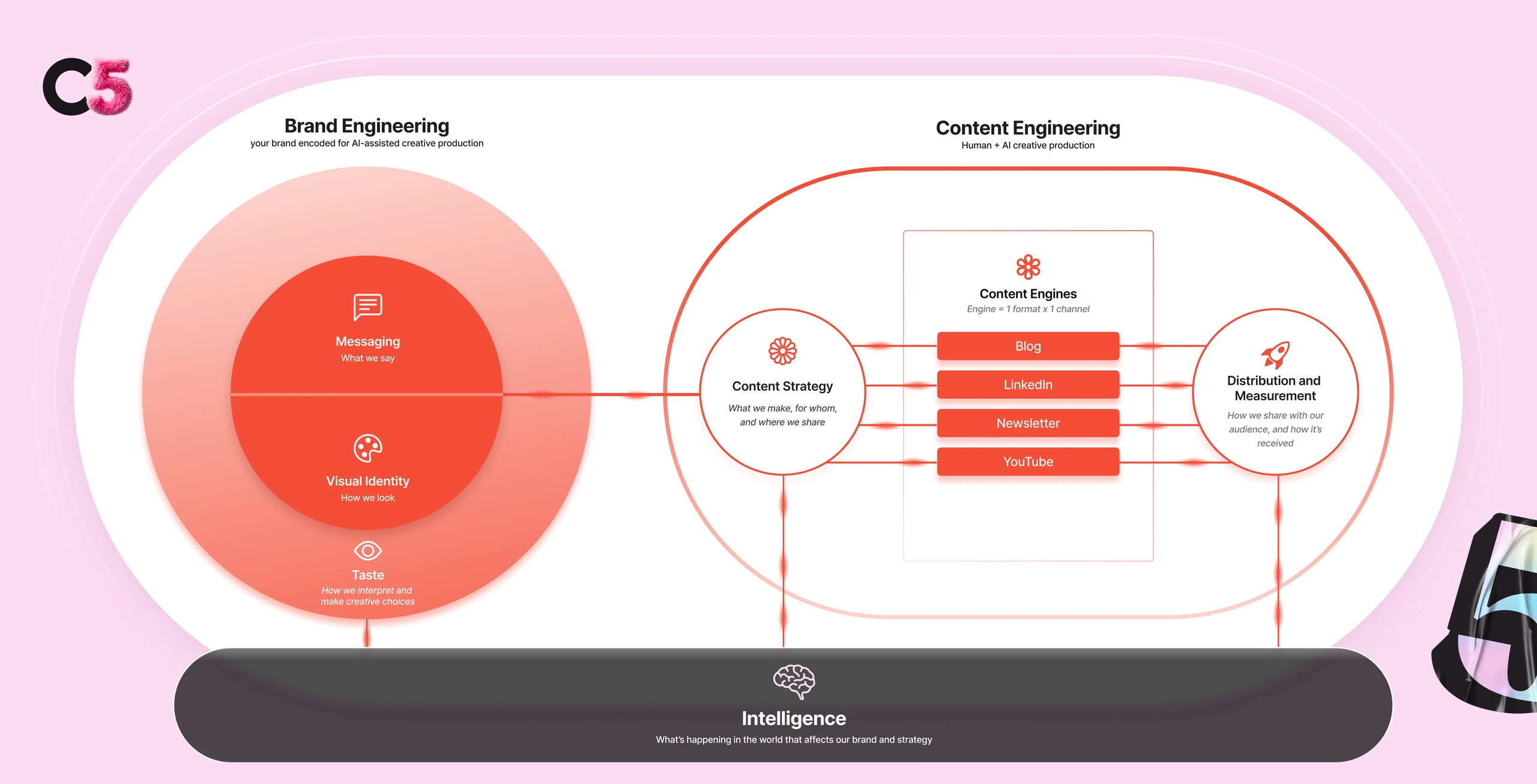
No engine runs alone. Each sits inside a larger content system, and the diagram we work from reads left to right: strategy decides what to make and for whom, the engines produce, and distribution and measurement close the loop.

The old model ran on creative scarcity
For most of the past decade, creation was gated by skill. Only trained craftspeople could make the work, because it took creative taste and specialized tool skills. That scarcity kept volume low, and low volume let brands govern at the exit, fixing whatever drifted after the work was made.
Two things have changed to create a better opportunity for scaled content production:
- First, the skill barrier fell. You no longer need years of training to make good work, because AI supplies a competent version of the execution. That opens creation to far more people with taste and something to say, and no review queue survives that volume.
- Second, the same tools moved governance to the front. Instead of fixing work after it exists, you encode the brand into the tooling before creation starts. When your messaging, visual identity, and taste are inputs, a newcomer’s first draft begins from the center of your brand. That is the opposite of the statistical middle that fills the web with AI slop. More than half of new web articles are now machine-generated, by one 2025 study. Democratized creation alone produces drift at scale. Paired with an encoded brand, it produces a working content engine.
The first draft is still a draft. The engine may raise the floor of quality, but the idea and the point of view must still come from the humans.
Every engine is a unique build
There is no standard content engine. The right mix of human and machine depends on your brand and your format, and the ratio inside each one keeps shifting as the tools improve. A brand campaign, an interactive report, a motion-graphics series, and a search-optimized blog are genuinely different machines.
Inside our blog engine
Our blog engine is a good example, because you are reading its output. We built it as a governed workflow we use for much of our writing work, and it runs at a roughly 70/30 split: the machine does about 70 percent of the labor, and the human owns the 30 percent that decides whether the piece is any good.
The Column Five blog engine works like this:
- A person sets the angle and decides whether the piece leans on perspective or research.
- Keyword, search, and AI-citation intelligence feeds the brief.
- The brand is encoded into the tool itself, so our voice, positioning, and proof points live inside the engine, and the first draft starts from our center.
- From there, the engine creates a first draft, including a review pass that strips away the common tells of machine-made writing (what we call AI-isms).
- A person edits for judgment, adds the client stories a human knows to reach for, and signs off before publishing.
- The hero image comes from Midjourney against our visual rules.
The machine carries the volume, and the human carries every decision that decides whether the work is worth publishing. An interactive or a motion-graphics engine leans far more human than a blog does.
It runs on the brand you encode into it
An engine is only as good as the brand encoded into it. When you feed it a generic brand document, you get generic output back, because a static PDF cannot travel into the tools where the work happens. The approach that works treats your brand as structured, portable, and machine-readable, with instructions written for each tool. Brand engineering does exactly that: it turns your messaging, visual identity, and taste into a system active at the moment of creation. This is the problem we built Brandcode (working title) to solve, and the idea holds whether or not you build it with us.
The experts moved upstream
The craftspeople are still the governors. What a senior creative does now is still governance, shifted from reviewing outputs to crafting inputs: encoding the taste, defining the anti-patterns, and designing the engines. It is the same governing job the brand team always had, now done at the entrance. This is why experience and taste matter more than ever, because a newcomer can produce a strong draft, but knowing which draft is right still takes a trained eye. The role is even getting a name: listings for content engineers have appeared at companies like Ramp and Notion.
How to build a content engine
You do not build a content engine from scratch. You already make certain kinds of content, so the real work is finding the discrete engine opportunities inside what you already do, one format and one channel at a time. The best place to begin is the format you produce most, because volume is where a working engine pays back fastest. From there, the exercise runs in six moves:
- Pick your highest-volume format and channel, like the weekly blog post, the campaign landing page, or the daily social video.
- Pull your three-to-five best examples of it, and study both what makes them good and how they actually got made.
- Write down the characteristics that make the best ones the best. That list is your quality bar for the format, made explicit instead of living in someone’s head.
- Encode those characteristics as instructions your tools can read. That written standard becomes the brand and quality your engine drafts from.
- Mark which characteristics needed a human. Was it the headline and angle, the custom illustration, or the witty line AI still cannot land?
- Design the workflow around that split. Let the tools handle everything you could encode, add an agent to manage the steps, and keep the human on the decisions you just marked as theirs.
Working through that per engine turns the accidental into the deliberate. It works best to start with one, get it right, and scale the pattern across your formats. Do that and you get what every content team wants: more people able to create, and better work coming out. If you want a partner for that build, we are happy to talk it through.
Frequently asked questions
What is a content engine?
A content engine is the specific mix of people, process, and tools that produces one format for one channel, such as a blog, a landing page, or a motion-graphics series. It carries the brand encoded inside and produces near-publish-ready work a person approves before it ships.
How is a content engine different from a content system?
A content system is the whole architecture that produces your content, including strategy, brand inputs, and measurement. A content engine is one machine inside that system, built around a single format and channel. The system is the operating model, and each engine runs on it.
What makes a content engine successful?
A successful content engine produces on-brand first drafts from anyone who uses it, keeps humans focused on judgment instead of mechanical production, and needs a lighter exit review over time. When quality slips, the cause usually sits upstream in the brand inputs or the human-to-AI ratio, well before the production step.




Let's upgrade your marketing game
Get fresh tips, how-tos, and expert marketing advice every week. (15,000 people already are.)