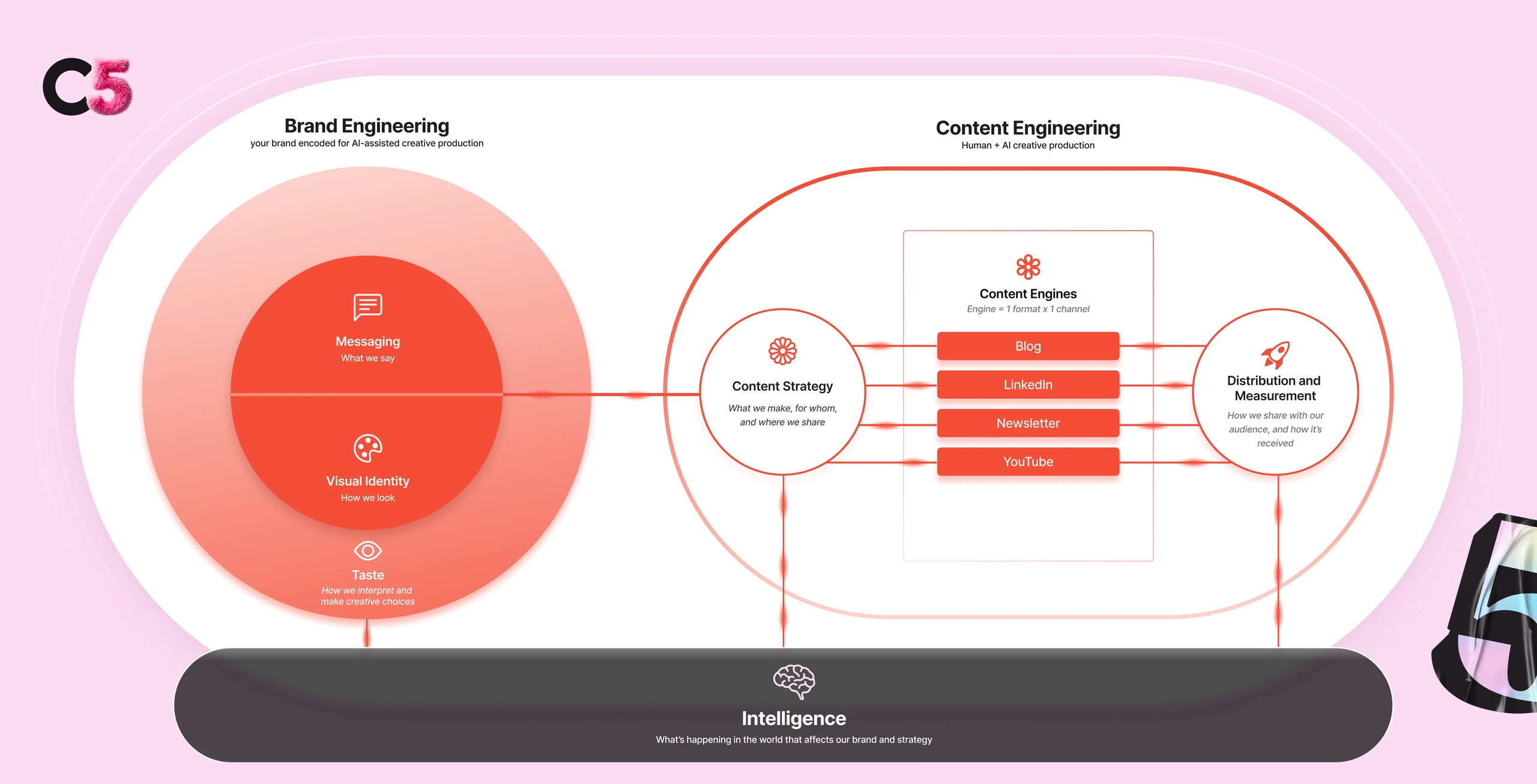

Column Five vs Foundation Marketing both serve B2B software companies through retainers starting around $10,000 per month, with credible coverage across search, AI tools, and modern distribution channels. The two agencies disagree on where the durable advantage lives. Foundation’s stated positioning treats distribution as the moat; Column Five treats creative as the part of the stack still gated by human judgment. This guide compares both agencies across services, pricing, ideal customer profile (ICP), content formats, and team model, then walks through how to decide in a market where media is automating quickly and standout creative remains gated by human judgment.
If you are weighing Column Five vs Foundation Marketing, you have already narrowed the field. Both agencies sit in the same retainer tier and serve B2B software companies, with the case studies to back up the sales call.
The honest answer is structural. The two agencies treat content marketing as fundamentally different problems. Foundation’s stated positioning treats content creation as table stakes and distribution as the durable advantage. Column Five treats creative as the durable advantage and distribution as the layer that benefits from automation. Picking between them comes down to where in your stack you want to invest in human judgment for the next three years.
This guide walks through where each agency excels, where the differences genuinely show up, and how to make the call. Both agencies cover the standard B2B content stack, including search engine optimization (SEO), answer engine optimization (AEO), and generative engine optimization (GEO), with different emphasis on which channels carry the program.
Column Five vs Foundation Marketing: Side-by-Side Comparison
| Dimension | Column Five | Foundation Marketing |
|---|---|---|
| Founded | 2009 | 2014 |
| Core strength | Brand narrative + multi-format creative engine | Distribution-first content program with Reddit, GEO, and SEO emphasis |
| Best for | B2B SaaS, AI, and enterprise teams that need narrative, design, and search to compound together | B2B software and higher-education teams whose narrative is already sharp and whose bottleneck is reach |
| Content formats | Editorial, video, motion, interactive, infographics, design systems | Editorial, research reports, social, podcasts, video, graphics |
| Distribution | SEO, AEO, paid social, owned channels, design-driven earned | Reddit, GEO, organic search, link-building, newsletter amplification, communities |
| Pricing | $10K+/month embedded retainer, three-month minimum | ~$20.5K execution roadmap + ~$30K quarterly retainers per public Clutch reviews |
| Notable clients | Dropbox, Instacart, Coinbase, J.P. Morgan, VideoAmp | Canva, Procore, Snowflake, Webex, Mailchimp, Jobber, Eventbrite |
| Team model | Embedded extension of your team across strategy, creative, and production | Distribution-led agency pod with project-plus-quarterly engagement structure |
The eight rows summarize the structural facts. The next two sections cover what those facts feel like inside a real engagement.
What Column Five Brings to the Table
Column Five operates from a clear thesis. A brand is the sum of what people believe about it, and those beliefs get shaped through the most powerful form of human communication, which is story. Founded in 2009, the team has run content programs for almost two decades across cycles and platforms. Strategy starts with the brand story before the keyword list. SEO work continues throughout the engagement, but it sits inside a larger narrative architecture so every blog post, infographic, video, and case study reinforces the same idea about who the company is and why it matters.
Format breadth is the second separator. In addition to editorial, the team produces motion graphics, interactive experiences, infographics, branded video, and design systems. For a B2B software or AI company that needs to look as smart as it sounds, that breadth matters. As a result, one partner covers the full creative stack, instead of three vendors stitched together.
Notable client work includes Dropbox, Instacart, Coinbase, J.P. Morgan, and VideoAmp. The VideoAmp engagement produced an 850% increase in marketing qualified leads (MQLs), with content across editorial, design, and account-based touchpoints. The J.P. Morgan Payments work shows up frequently because it represents a non-software enterprise vertical most B2B content agencies cannot credibly serve.
The team model centers on being an embedded extension of your in-house team. In practice, strategy and creative leads sit in your weekly stand-up. Your roadmap shapes the production calendar. Quarterly reviews tie content output to the metrics your chief marketing officer (CMO) already reports on.
What Foundation Marketing Brings to the Table
Foundation Marketing’s organizing thesis is that distribution is the durable advantage in content marketing. The agency was founded in 2014 by Ross Simmonds, with offices in Halifax, Nova Scotia, and Philadelphia. Its stated positioning, taken directly from the agency’s homepage, is “Most agencies create content. We make it impossible to ignore.” Content creation is treated as table stakes. Distribution across Reddit, large language model (LLM) outputs, organic search, communities, and owned newsletter channels is treated as the durable advantage.
One naming clarification matters. Foundation Labs is a separate offering inside the Foundation business, a paid data and research subscription publishing weekly B2B marketing intelligence. The agency itself sells client engagements under the Foundation Marketing brand. Agency buyers are evaluating Foundation Marketing; data subscribers are buying Foundation Labs.
Foundation’s service shape, clients, and pricing
The service shape reflects the agency’s distribution-first thesis. Foundation organizes work across four pillars: research, content creation, distribution, and optimization. Distribution is where the agency draws most of its public attention, with particular emphasis on Reddit strategy. Foundation reports working with Canva, Procore, Snowflake, Webex, Mailchimp, Jobber, Unbounce, Eventbrite, and Bitly. The agency claims more than 220 million organic visits generated for B2B software clients across its history. Those numbers come from Foundation’s own materials and should be evaluated as such.
Pricing is harder to pin down from Foundation’s own materials. However, public Clutch reviews reference engagement structures around a $20,500 execution roadmap plus quarterly retainers near $30,000. As a result, that cadence positions Foundation closer to a project-plus-quarterly model than the embedded monthly retainer Column Five operates.
In short, Foundation’s machinery is purpose-built for buyers whose category is well-defined, whose narrative is already sharp, and whose biggest content gap is reach into Reddit, AI search, and earned distribution.
Free Download — The B2B Content Marketing Agency Scorecard Template. Eleven criteria, weighted scoring, and a side-by-side worksheet for any two agencies you are evaluating.
Where the Difference Actually Shows Up
The eight-row table makes the differences look symmetrical. In practice, four dimensions do most of the work in deciding which agency is the right call.
Creative-first versus distribution-first sequencing
Both agencies eventually do creative and distribution work, but the sequence matters. Specifically, Foundation begins with channel and intent analysis, then engineers content for those channels to absorb and amplify. By contrast, Column Five begins with brand narrative and creative direction, then layers distribution into the work as it goes to market. In practice, whether your category has a stable language and well-established intent patterns determines which sequence wins. For example, new or contested categories tend to need narrative leadership first, because keyword data is still catching up. On the other hand, mature categories with stable buyer intent tend to reward distribution-first execution, because the channels are already settled.
What is automatable versus what is defensible
This is the dimension that matters most over the next three years, and the one most B2B marketing leaders are not yet pricing into agency selection. Distribution work is being absorbed by AI tooling at speed. The list includes channel selection, programmatic placement, scheduling, audience splits, personalization at scale, and most of the daily operational loop. Brand-side and agency-side teams already use LLMs to draft Reddit posts, calibrate newsletter cadence, generate social variants, and run on-page optimization. The gap between automated and human-led distribution engines keeps narrowing.
Conversely, creative that earns attention is moving in the opposite direction. To clarify, AI can generate competent average creative all day. However, standout creative, the kind that gets remembered and quoted inside buyer conversations, still requires human taste and editorial judgment models cannot substitute. In short, Foundation’s value lives in the layer AI is absorbing. Meanwhile, Column Five’s value lives in the layer becoming relatively scarcer as AI capability rises.
The implication for agency selection is direct. Investing in distribution as your strategic moat means investing in a layer where AI tooling is rapidly closing the gap. Investing in creative judgment means investing in a layer where the gap between competent and exceptional output is widening, and where human taste is the bottleneck.
Format breadth versus channel breadth
Foundation’s specialty is breadth across distribution channels, with documented depth in Reddit, communities, and LLM-targeted optimization. By contrast, Column Five’s specialty is breadth across content formats, with in-house production for video, motion, interactive, infographic, and design systems alongside editorial. For example, if your roadmap calls for a flagship interactive or brand video alongside search, Column Five covers both. On the other hand, if your roadmap is mostly written content needing amplification, Foundation runs leaner against that brief.
Embedded extension versus distribution-led pod
Column Five operates as an embedded extension of your team, with strategy and creative leads sitting inside your operating cadence. By contrast, Foundation operates as a distribution-led agency pod with its own playbook and process. In practice, the embedded model integrates faster with internal stakeholders. On the other hand, the distribution-led pod is more standardized, easier to manage when your in-house team already runs cleanly and just needs a distribution partner.
How to Decide Between Column Five and Foundation Marketing
If you have read this far and still feel uncertain, the two lists below will move the decision faster than another sales call.
Column Five is a better fit if:
- Your roadmap calls for video, motion, interactive content, or design alongside editorial.
- Your category is new or contested enough that brand narrative needs to lead before keyword and channel data can.
- You operate in a hybrid business model or non-software vertical, such as financial services, AI infrastructure, or enterprise marketplaces.
- You want a partner that integrates as an embedded extension of your in-house team.
- You believe creative judgment is the durable differentiator over the next three years, and you want to invest in the layer of the stack AI is unlikely to absorb.
Foundation Marketing is a better fit if:
- Your story is already sharp, your category is well-defined, and your bottleneck is reach.
- Reddit and community marketing are central to your distribution plan, and you want a partner with public depth in those channels.
- Your in-house team already owns brand narrative, design, and creative, and you need a partner who plugs in at the distribution layer.
- You prefer a project-plus-quarterly retainer cadence over an embedded monthly retainer.
- Your immediate priority is scaling content visibility across LLMs, organic search, and earned channels using a distribution-led playbook.
If you want a more structured way to compare any two agencies, the Agency Scorecard Template walks through the eleven criteria most B2B teams use to make this call. If your shortlist still includes more than these two agencies, our roundup of best B2B content marketing agencies for 2026 covers the broader field. For the full evaluation process from request for proposal (RFP) through onboarding, the deeper guide on how to choose a B2B content marketing agency walks through what to ask and what to look for.
Frequently Asked Questions
Is Column Five or Foundation Marketing better for B2B SaaS?
Both serve B2B SaaS well; the right pick depends on what is broken. In short, Column Five tends to win when the SaaS company also needs brand narrative work, multi-format content, or design support alongside SEO. By contrast, Foundation tends to win when the narrative is already sharp and the most pressing growth lever is reach across Reddit, AI search, and community channels.
How does Foundation’s distribution-first approach compare to Column Five’s content engine?
Foundation organizes its program around channel-led execution; in contrast, Column Five organizes around narrative-led production. For example, Foundation builds content with channel mechanics already in mind, including how the Reddit thread, LLM citation, and link-building partnership will look. Column Five, on the other hand, builds the brand story first, then ladders editorial, design, and video work into a multi-format engine that distributes across owned, earned, and paid channels. As a result, Foundation moves faster when the narrative is already locked, while Column Five moves faster when the narrative still needs work.
How does pricing actually compare?
Both start around $10,000 per month or the project equivalent. Specifically, Foundation’s public Clutch reviews reference an execution roadmap near $20,500 followed by quarterly retainers around $30,000, which positions the structure as project-plus-quarterly billing. By comparison, Column Five typically scopes engagements as embedded creative pods at $10,000 to $80,000 per month with a three-month minimum, depending on the mix of strategy, editorial, design, and video. In practice, the same monthly floor stretches differently depending on which formats are in the brief.
Can I work with both agencies at the same time?
In some configurations, yes. A common pairing uses Foundation as the dedicated distribution program for Reddit, GEO, and link-building while Column Five handles brand narrative, creative formats, and the editorial spine. The risk is duplicated strategy work and unclear ownership of the editorial calendar. Define ownership in writing before either engagement starts:
- Which agency owns the content roadmap?
- Which owns brand voice and creative guidelines?
- Which owns distribution strategy across channels?
Settled answers up front will save the program from drift later.
Which agency is stronger on AEO, GEO, and LLM visibility?
Both agencies offer answer engine optimization (AEO) and generative engine optimization (GEO) services and can credibly help a B2B brand surface in ChatGPT, Claude, and Perplexity. In fact, according to Wynter B2B Buyer Research 2026, 84% of enterprise B2B buyers now use AI tools as a primary discovery channel, up from 24% twelve months earlier, so the question genuinely matters. Specifically, Foundation has invested publicly in GEO methodology and has visible cited-source presence in AI tool outputs for distribution and B2B agency queries. Meanwhile, Column Five integrates AEO into its broader content programs with emphasis on narrative coherence and the structured content signals that LLMs use when citing a brand. Either way, ask both agencies for their tracking methodology and published case studies before signing. For the structural difference between AEO, GEO, and traditional SEO, our explainer on AEO vs SEO covers the discipline-level distinctions.
Ready to make things happen? Let’s chat about what your next twelve months should look like.
If you are also evaluating other agencies in this tier, we have published structured comparisons against Omniscient Digital, Animalz, and Siege Media.




Let's upgrade your marketing game
Get fresh tips, how-tos, and expert marketing advice every week. (15,000 people already are.)