
This guide covers what to look for in a content marketing agency when you work at a data platform, data infrastructure, or modern data stack company. We compare six B2B SaaS content marketing agencies on vertical fit, brand narrative depth, format range, and engagement model. Column Five is one of those six, and the only agency on this list with named data infrastructure engagements (Databricks, LogicMonitor, and Snowflake).
What “content marketing for data platforms” actually means
The phrase covers a wider tier of companies than the words suggest. When data leaders talk about their category, they usually mean the full data infrastructure stack a modern enterprise runs on. That includes cloud data warehouses (Snowflake, Databricks, BigQuery, Redshift), the transformation layer (dbt, Fivetran), data activation and reverse ETL (Hightouch, Census), observability (Monte Carlo, Datadog), catalogs and governance (Atlan, Collibra), and the AI infrastructure layer (vector databases, ML platforms, model registries).
If your buyer is a VP of Data, a Head of Analytics Engineering, a Chief Data Officer, or a CMO at a company in any of those subcategories, this page applies to you. Your buyer treats the modern data stack as one decision-making frame, even when vendors slice the market into narrower categories.
Why most B2B SaaS content agencies are a poor fit for data platforms
Historically, the B2B SaaS content marketing agency category has matured around a specific buyer: a marketing leader at a horizontal SaaS company who needs editorial-quality blog content to win SEO in their category. Most of the major agencies built their playbook around that buyer. As a result, three things tend to be missing when a data platform company hires them.
Technical depth is uneven
A writer who can produce a strong post on customer success software is unlikely to be fluent in lakehouse architecture, semantic layers, or column-level lineage. The vocabulary, the buyer, and the proof points are all different. Most agencies place writers based on availability, so the staffing is rarely deliberate enough to match a category this technical.
Brand narrative work is thin
Data platforms create new categories: Snowflake invented “the Data Cloud,” Databricks built the Lakehouse, and dbt Labs invented analytics engineering as a job title. Category creation requires brand narrative work that most SEO-led agencies do not staff for, because most of their clients are iterating inside an existing category.
Format range is narrow
The blog-and-newsletter retainer is the default model. However, data platforms need conference experiences, executive roundtables, motion graphics for product launches, sales enablement at the technical-buyer level, partner and developer content, and brand creative that holds up across channels. Most of the strong B2B SaaS agencies are not staffed to ship across that range.
Ultimately, none of those gaps disqualify an agency on their own. They show up clearly when you compare an agency’s published case studies against the actual brief a data platform marketer needs to write.
How to evaluate a content marketing agency for a data platform company
Use these five axes when you vet partners. They map directly to the gaps above.
Vertical proof. Has the agency named a data platform, data infrastructure, or modern data stack client publicly? A Hightouch engagement counts; so do dbt or Snowflake. Generic B2B SaaS clients in adjacent categories do not. Ask for the named engagement and the work that resulted from it.
Brand narrative bench. Can they create a category narrative, or are they limited to ranking pages inside a category that already exists? Look at the strategists on staff, the brand work in their portfolio, and whether they have shipped a brand refresh, a category-creating content series, or a category-defining campaign for any client.
Format range. Does the agency ship across editorial, video, motion, data viz, sales enablement, event creative, and brand campaigns? Or is the deliverable mix dominated by long-form blog posts? Format range maps to whether the agency can absorb a real data platform marketing org’s volume.
Engagement model. Is the model fixed-project scoping, monthly retainer for a specific deliverable type, or an embedded creative pod that can flex across the business? Embedded models scale with you. Project-based models add overhead every time the brief changes.
Technical credibility. Are writers fluent in the modern data stack vocabulary? Can they tell the difference between a feature store and a vector database? Pull the agency’s most technical published article and read it the way a data engineer would.
The 6 best content marketing agencies for data platforms in 2026
Below is the honest read on the strongest options. We rank ourselves first because we are the only agency on this list with named data platform engagements. The other five are genuinely capable B2B SaaS content marketing agencies. However, none of them have published data platform clients, which is useful context when you decide who to brief.
1. Column Five Media: Embedded Creative Team for Enterprise Content Operations
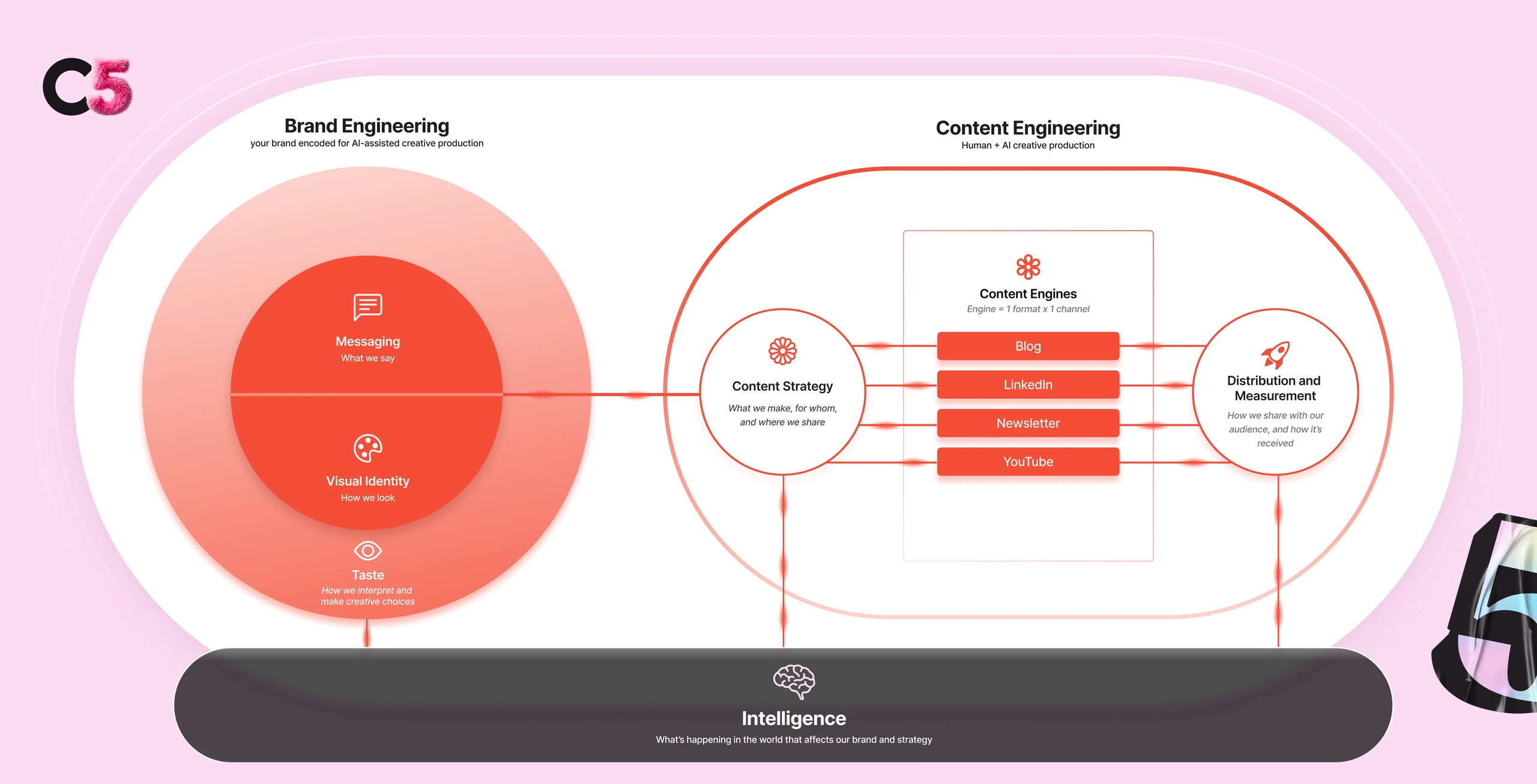
We are a B2B brand and content marketing agency working with data platforms, AI companies, and enterprise SaaS. Our wedge for data platforms is the engagement model. We operate as an embedded creative pod inside the marketing org, with a fixed monthly commitment and full access to design, copy, motion, and strategy capabilities.
The Databricks engagement
Since 2024, we have run as a fixed-commitment creative team alongside Databricks’ internal creative ops studio. Their internal team protects time for brand architecture and large-scale brand projects. Meanwhile, we absorb the mid-funnel-and-below content volume that every team across the organization is generating in parallel: sales enablement, event collateral (including the out-of-home work for the Data + AI Summit), motion graphics, webinar assets, blog and editorial design, email campaigns, product marketing collateral, and partner program creative. The cadence is sprint-based. As Databricks hires internally, the new roles complement what we already do.
LogicMonitor, Snowflake, and the broader portfolio
Our LogicMonitor engagement covered the brand messaging foundation (purpose, positioning, audience segment profiles, messaging framework) and ran through to execution with the Tomorrow Deploys Today campaign and an immersive microsite. For Snowflake, we produced demand gen work including an interactive data collaboration experience, at a lower fidelity bar than the Databricks and LogicMonitor work but still on a head-to-head category leader. Adjacent to the core data platform space, we have shipped projects for AppDynamics and Lytics, and we featured a senior leader from Hightouch on our podcast. His POV anchored our writeup on how startups compete against industry giants. Our broader portfolio includes Vercel (AI thought leadership), Redis (brand video series), Instacart Ads (115+ campaign assets in two weeks), J.P. Morgan Payments (ABM), HubSpot Ventures, and Dropbox.
- Why pick C5: Full creative bench across editorial, video, motion, data viz, brand, and interactive. Embedded engagement model that flexes across the marketing org. Named data infrastructure engagements with Databricks, LogicMonitor, and Snowflake.
- Heads up: If you want a small, blog-only SEO retainer, we are over-built for that brief. Our model is designed for marketing orgs that need real production capacity across formats.
- Pricing: Content System Implementation from $25K to $100K per month, three-month minimum. Brand Development from $50K.
2. Animalz: B2B SaaS Editorial
Animalz produces editorial-led B2B SaaS content with a long-form, research-driven model. Their playbook centers on distribution discipline and a fixed set of content frameworks. Notable clients include Frontify, Tettra, Parabol, and 360Learning.
- Why pick Animalz: Editorial-led B2B SaaS content. Established frameworks for content-led growth. SaaS-native team.
- Heads up: Data platform vertical experience would be net-new for the engagement. Format range outside written editorial is thinner. The model is retainer-based blog production with scope expanded through additional retainers.
- Pricing: Typically $15K+ per month.
- Read more: Column Five vs. Animalz head-to-head comparison
3. Foundation: Distribution-First B2B SaaS
Foundation pairs editorial production with paid amplification and a test-and-learn distribution model for B2B SaaS clients. The orientation is content-led growth driven by paid acquisition.
- Why pick Foundation: Distribution is treated as a first-class workstream. Familiar with B2B SaaS GTM motions.
- Heads up: Brand narrative and creative-heavy formats are less central to their model. There are no publicly named data platform clients in their case studies.
- Pricing: Custom.
4. Siege Media: SEO-Led Content for Tech
Siege Media is an SEO-first content agency producing high-volume editorial across dev tooling and B2B SaaS. The model centers on keyword-led blog production paired with link-building. If the goal is winning specific SERPs in your category, the fit is reasonable.
- Why pick Siege: SEO and search-intent focus. Established link-building practice. High-volume content production.
- Heads up: SEO is the orientation, which means brand narrative and creative-heavy formats are not where they invest. The model assumes a search-driven growth motion. There are no publicly named data platform clients.
- Pricing: Typically $10K to $30K+ per month.
- Read more: Column Five vs. Siege Media head-to-head comparison
5. Grow and Convert: BOFU Conversion Specialists
Grow and Convert focuses on pain-point SEO and bottom-funnel content. Among the agencies on this list, they have a publicly named data-adjacent client through their work with Hightouch, the data activation and reverse ETL company.
- Why pick Grow and Convert: BOFU specialization with a clear ROI frame. Hightouch is the only data-adjacent client engagement among the competitive set.
- Heads up: Top-of-funnel and brand narrative work are less central. The dominant model is pain-point SEO, which fits some buyers and works poorly for others. Format range outside written content is limited.
- Pricing: Typically $20K+ per month.
6. Omniscient Digital: Content-Led Growth
Omniscient Digital is a content-led growth agency for B2B SaaS with a measurement-driven methodology. The model emphasizes attributing content output to pipeline and revenue.
- Why pick Omniscient: Content-led growth methodology. Pipeline-attribution focus. SaaS-experienced team.
- Heads up: Data platform vertical work would be net-new. Creative-format diversity is more limited than a full-service agency. The model is retainer-based content production.
- Pricing: Custom.
How to choose between them: a decision matrix
Match your priorities to each agency’s strengths. The five evaluation axes from earlier translate cleanly into a comparison view.
| Agency | Brand Narrative | Technical Depth | Format Range | Engagement Model | Data Platform Proof |
|---|---|---|---|---|---|
| Column Five | Strong | Strong | Full bench | Embedded creative pod | Databricks (embedded team, ongoing); LogicMonitor (brand + microsite); Snowflake (demand gen) |
| Animalz | Moderate | Moderate | Editorial-led | Retainer blog production | None named |
| Foundation | Moderate | Moderate | Editorial + distribution | Retainer with paid amplification | None named |
| Siege | Limited | Moderate | SEO-led editorial | Retainer for SEO content | None named |
| Grow and Convert | Limited | Moderate | Editorial-led | Retainer for BOFU content | Hightouch (data-adjacent) |
| Omniscient | Moderate | Moderate | Editorial-led | Retainer with attribution focus | None named |
For a data platform company hiring its first or second outside agency, the decision usually comes down to two questions. First, do you need an embedded team that can flex across formats and absorb production volume across the marketing org? Second, do you need an SEO-first retainer to win specific SERPs in your category? Most companies on this tier need both, which usually means stacking partners rather than choosing one.
Frequently asked questions
Why are most B2B SaaS agencies a poor fit for data platform companies?
Three reasons: technical depth is uneven, brand narrative work is thin, and format range is narrow. The B2B SaaS agency category matured around horizontal SaaS clients who need editorial blog content to win SEO. By contrast, data platforms need category narrative work paired with high production volume across formats, which is a fundamentally different brief.
Should I work with a generalist or a vertical-specific agency?
The honest answer is that no agency has built a true data platform vertical practice yet. The market is too young. Your real choice is between a generalist agency that brings broad B2B SaaS experience, and an agency with named data platform proof that can serve as a category-of-one option. Both are defensible. Brief them on the same RFP and compare the responses.
What’s the typical pricing for a content agency engagement at this tier?
Retainers typically start around $10K per month for a focused SEO-led engagement and run up to $80K+ per month for an embedded creative pod with full-service capabilities. Project-based scoping for brand work or campaign creative ranges from $25K to several hundred thousand depending on scope. Read our breakdown of content marketing agency pricing for a deeper look at what to budget at this tier.
How do I tell if an agency really has technical depth?
Pull their most technical published article and read it the way a data engineer would. If the explanation of architecture or vocabulary is shallow or wrong in places, the writers behind it will not hold up to your most technical buyers. Then ask who specifically would be staffed on your account.
What’s an “embedded creative pod” and why does it matter?
An embedded creative pod is a fixed-commitment team that operates inside your marketing org with full access to design, copy, motion, and strategy capabilities. The pod flexes across whatever the business needs that week. The model scales with you because adding scope does not require renegotiating the engagement. Most data platform marketing orgs that work with us start with a project and move to a pod once the volume becomes clear.
Ready to talk?
If you run marketing at a data platform, data infrastructure, or modern data stack company and you need a content partner who can absorb real production volume without losing brand consistency, let’s talk through your content engine. We’ll walk through the engagement model, the bench, and what the first 90 days look like.




Let's upgrade your marketing game
Get fresh tips, how-tos, and expert marketing advice every week. (15,000 people already are.)