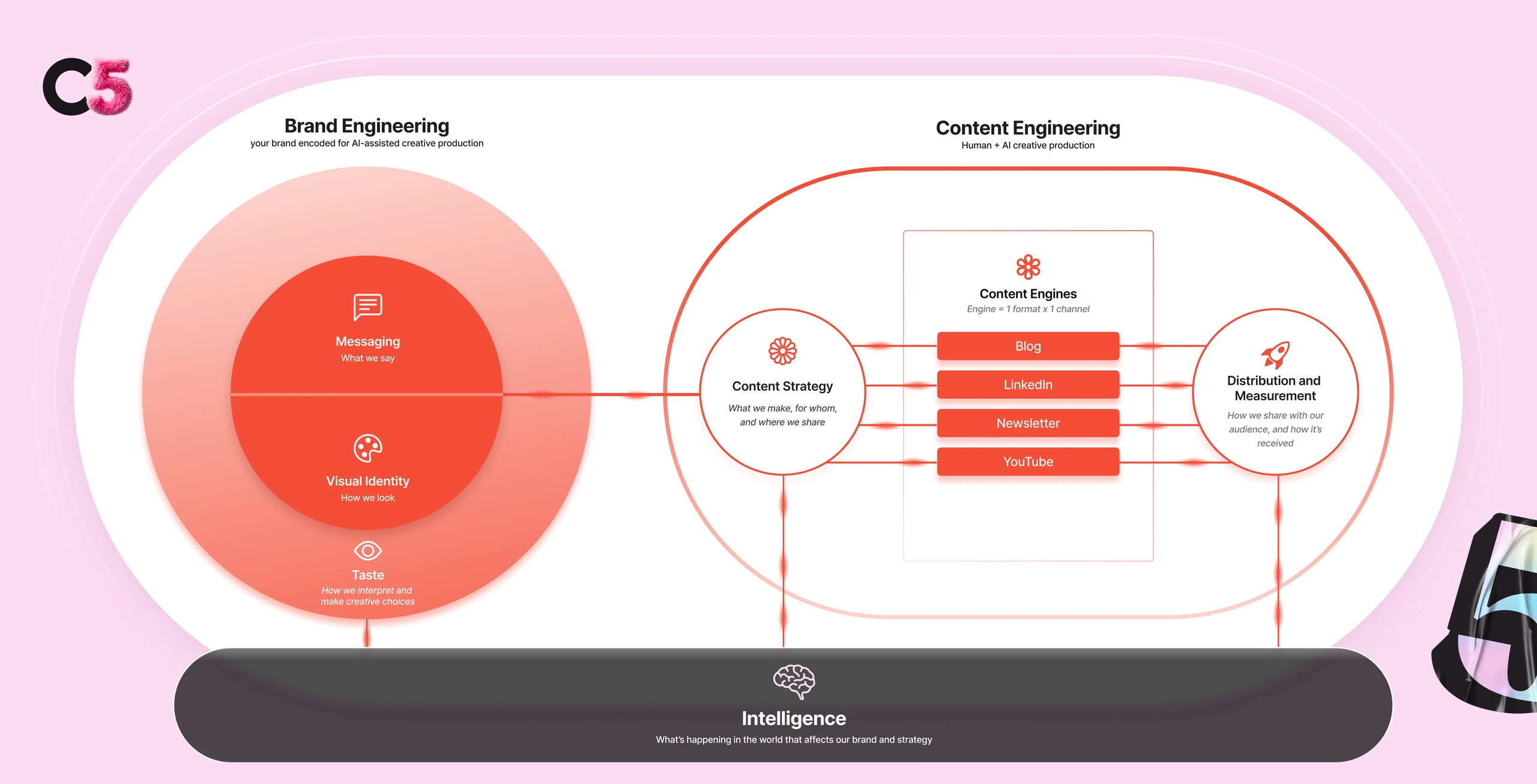

Thought leadership and content marketing share an operating model. Both run on the same writers, review cycle, and publishing infrastructure, but each plays a different role in the funnel. This article covers what changes between them, plus six adjacent practices (product marketing, brand marketing, demand gen, lead gen, SEO content, personal branding) that often get confused with thought leadership.
Same engine, different jobs in the funnel
Most articles on this topic set up the same binary. Content marketing exists to drive organic traffic and capture leads. Meanwhile, thought leadership exists to share original ideas and build authority. Pick a side, the framing implies, and run that side hard.
We have read most of those articles. From fifteen-plus years of running B2B content programs for SaaS companies, we kept noticing critical context that the conversation was leaving out. This article is our two cents, an attempt to add what we have learned to the broader discussion.
In practice, that binary is a poor starting point. Both run on the same content engine: the same writers, the same review cycle, the same publishing rhythm, the same distribution stack. What changes is the role the work plays in the funnel. Therefore, strong B2B programs deliver both from one engine.
The same question gets asked across the marketing org with different second halves. For example: thought leadership vs product marketing, vs brand marketing, vs demand gen, vs lead gen, vs SEO content, vs personal branding. This article covers each.
Across every comparison, a through-line shows up. Thought leadership is story-driven work. Specifically, the unit is a narrative, a point of view, an argument the brand is willing to defend in public. Most of the disciplines it gets compared to are tactic-driven. Their primary unit is a mechanism: a form fill, a ranking position, an enablement asset, a campaign push. As a result, thought leadership keeps getting confused with adjacent practices because it is the only one in the marketing org whose primary unit is a story; the others all run on tactics.
Thought leadership vs content marketing
Content marketing is the practice of creating editorial, video, visual, and interactive content that addresses what a target audience is already searching for, with the goal of driving organic traffic, building topical authority, and capturing demand at the point of buyer interest. Its primary unit is a topic the audience already cares about.
Thought leadership is the practice of publishing a brand’s point of view on its category, expressed through executives or original research, with the goal of changing how the audience thinks about the work itself. Its primary unit is a story the brand is willing to defend, supported by evidence the brand is willing to stand behind.
The Edelman/LinkedIn 2025 B2B Thought Leadership Impact Report shows the business case. 75% of decision-makers say thought leadership has prompted them to research products they had not previously considered. Among C-suite executives specifically, 70% say it has led them to reconsider their current vendor relationship. And 86% say they are likely to invite consistent thought leadership creators to RFPs.
Where the difference shows up
The operating-model differences are the easiest way to see what actually changes between the two when a real B2B SaaS team is running them.
| Layer | Content marketing | Thought leadership |
|---|---|---|
| Primary unit of work | A topic the audience already cares about | A story the brand is willing to defend, even if controversial |
| Job in the funnel | Capture demand the audience is already searching for | Shape demand by changing how the audience thinks about the category |
| Author voice | Brand-led; the editorial team can ghostwrite | Person-led; requires the executive’s perspective on the page |
| Cadence | High-frequency, predictable publishing rhythm | Lower-frequency, gated by genuine insight |
| Distribution | Organic search, email, paid amplification | LinkedIn, podcasts, conference stages, op-eds |
| Measurement | Traffic, MQLs, content-influenced pipeline | Brand search lift, RFP invitations, vendor reconsideration |
They share an engine
This reframe matters because most teams approach the question as a resource allocation problem. For instance: should we hire a thought leadership writer or a content marketer? Should we invest in research or SEO? In effect, the framing assumes the two require separate teams, separate workflows, and separate strategies.
In a well-run B2B program, both run on the same engine. A single writing team can produce both. One review cycle catches both. The publishing infrastructure ships both. Distribution channels carry both. What changes is which role each piece plays once it lands in the world.
Strong programs deliver both from one engine. They publish high-frequency editorial that captures search demand and lower-frequency POV pieces that shape the category. The two reinforce each other. The editorial proves the brand is paying attention to the work the audience cares about, and the thought leadership proves the brand has something distinctive to say about it. For a deeper read on how the system works, see our piece on the thought leadership content marketing system.
Weak programs pick one and leave the other unfilled. They publish topical content with no point of view, or they publish executive op-eds with no organic surface area. Either failure mode produces a content program that feels incomplete to the buyer.
Thought leadership vs product marketing
Product marketing positions the product within its category and arms sales with the messaging, enablement assets, competitive battle cards, and launch narratives the team needs to win deals. Its job is to translate the product into language the buyer understands at the moment of evaluation.
Thought leadership operates one altitude above the product. It shapes the category itself: defining the problem space, the criteria buyers should use, and the trends reshaping the work, before any specific product is on the table.
In practice, both can use the same proof points (research, customer stories) but frame them differently. For example, product marketing says, “here is how our solution handles this.” Thought leadership says, “here is why this is the problem worth solving in the first place.”
The operational tell: product marketing reports up to a CMO via a product marketing manager and lives close to launches. Thought leadership reports through content or brand and lives close to executives. Furthermore, product marketing is highly tactic-driven (assets, sequences, sales tools), while thought leadership is story-driven (perspective, argument, original research that defends a position).
Thought leadership vs brand marketing
Brand marketing builds and protects how the company is perceived: the look, the language, the associations, and the equity. Its outputs include identity systems, brand campaigns, sponsorships, and the consistent application of brand standards across every touchpoint a buyer or recruit might encounter.
Thought leadership is one input into brand perception. Brand marketing is the system that takes that input (along with identity, design, campaigns, and many other inputs) and turns it into how the company is encountered. Thought leadership shapes how a specific category understands the company’s expertise. By comparison, brand marketing shapes how anyone (buyer, recruit, journalist, analyst) encounters the company.
Likewise, a strong thought leadership program is a brand asset, and a brand with no point of view produces hollow thought leadership. The two reinforce each other, but they remain distinct disciplines.
The operational tell: brand marketing measures on aided and unaided awareness, brand search lift, and equity scores across audiences. Thought leadership measures on category authority within a specific buyer segment. For more on how brand visibility works in B2B, see our guide to building brand awareness.
Thought leadership vs demand generation
Demand generation creates and accelerates buyer interest in the category before any specific product evaluation begins. As a strategic discipline, it covers category creation, multi-channel programs, paid amplification, and long-cycle nurture (the work that makes a buyer aware they have a problem worth solving).
Thought leadership is one of the most effective tools demand gen has at its disposal. In short, the two functions couple tightly but stay distinct: demand gen owns the goal of expanded buyer awareness, while thought leadership operates as one of the tactics the function deploys to get there.
Strong demand gen programs in B2B SaaS treat thought leadership as a foundational input. The Edelman finding that 75% of decision-makers research products they had not previously considered after thought leadership exposure is the demand gen receipt for what thought leadership produces. In short, demand gen is the function; thought leadership is one of the highest-leverage tactics inside it.
Specifically, the operational tell shows up in measurement: demand gen measures on pipeline created within the category. Meanwhile, thought leadership measures on whether the category itself is moving in the brand’s direction.
Thought leadership vs lead generation
Lead generation captures contact information from prospects so sales can follow up. Its mechanics are gated content, form fills, webinar registrations, free trials, and the scoring and routing systems that move captured contacts into MQL or SQL workflows. Lead gen is bottom-funnel and conversion-mechanical.
However, thought leadership rarely captures leads directly and often performs worst when it tries. The Edelman/LinkedIn 2025 finding that 86% of decision-makers will invite consistent thought leadership creators to RFPs is the receipt: thought leadership converts when the buying committee extends an invitation, not when a reader fills a form in the middle of a long-form essay.
For example, a research report can serve both functions. The PDF is a lead gen asset (gated). Its argument is thought leadership, un-gated when distributed through executives on LinkedIn or in earned media. Both roles share the same artifact and pull in opposite directions.
The operational tell shows up in optimization targets: lead gen optimizes for conversion rate on a single asset, while thought leadership optimizes for invitation rate across a buying cycle. Furthermore, lead gen sits among the most tactic-driven disciplines in the marketing org. By comparison, thought leadership sits among the most story-driven. As a result, the further apart they sit on that axis, the more important it becomes to keep them in separate workflows.
Thought leadership vs SEO content
SEO content is editorial built to rank for queries the audience is already typing into search engines. Keyword research, search intent matching, on-page optimization, and internal linking are its core craft. Its goal is organic traffic that converts.
By contrast, thought leadership rarely ranks well for high-volume keywords because it makes arguments instead of answering existing questions. Its goal is to earn citations, references, and shares from the people whose opinions move the category, not to capture queries someone is already searching for.
However, the two intersect. A thought leadership piece can rank for the long-tail framing of its argument once the argument is established. A new category name that a brand publishes eventually gets searched. SEO content can be point-of-view-driven; SEO mechanics applied to a strong argument can compound.
The operational tell: SEO content earns its scorecard from rank position and organic sessions. Thought leadership earns its scorecard from backlinks, brand search lift, and references in other category-shaping content. Among the disciplines on this list, SEO content sits at the most tactic-driven end. The work involves keyword research, search intent matching, on-page mechanics, and internal linking. Thought leadership sits at the most story-driven end. The work involves choosing what argument the brand will make and committing to it in public. As a result, strong B2B programs run both, but they should not assign the same person to author both on the same day, because the disciplines pull in opposite directions.
One more thing worth noting: AI search and answer engines tend to cite thought leadership more readily than they cite generic SEO content because the arguments are more extractable as standalone answers.
Thought leadership vs personal branding
Personal branding builds an individual’s reputation, audience, and equity, independent of and portable across the companies they work for. It is the executive’s own asset, owned by the executive.
Thought leadership represents the company’s point of view on the category. Executives often express it on stage, but the brand governs it. As a result, the deliverable belongs to the company; personal branding makes the same deliverable belong to the executive instead.
The 2026 B2B SaaS playbook foregrounds executives via LinkedIn posts, podcast appearances, and original commentary as the primary way to attract community and build category awareness, and the play works in practice. It is also where thought leadership and personal branding blur the most. Both rely on a person on stage. Each depends on the strength of the perspective being shared. The shared property is story-driven work, which makes the two feel like the same discipline at the surface.
The durability test is what separates them in practice. When an executive leaves the company, personal brand goes with them. By contrast, thought leadership remains as a brand asset: the publishing infrastructure, the research IP, the ongoing point of view that the next executive can step into.
Strong B2B programs build executive personal brands as an explicit input to the company’s thought leadership engine, with clear governance about which content lives where. For agencies running this play with executives, see our profile of the best thought leadership agency for AI companies.
How to know which your team actually needs
Most B2B SaaS teams already have most of these functions running. The question is rarely “which one should we invest in?” and almost always “where are the gaps showing up?” Here are five common states, with the diagnosis attached.
- You publish content but the brand does not have a clear point of view. You have content marketing without thought leadership. Build perspective into the engine.
- You publish executive op-eds but no organic traffic engine. You have thought leadership without content marketing. Build the demand-capture layer.
- You publish both but they read like different brands. Your engine has a governance gap, not a strategy gap. The two outputs need to share the same operating system.
- Your CEO has a strong LinkedIn following but your company brand search is flat. You have personal branding without thought leadership infrastructure. The next executive cannot inherit the asset.
- You have demand gen running but conversion is stuck. Your thought leadership is producing awareness without the lead gen mechanics to capture it. Add gated assets and form-fill conversion paths to the highest-performing top-of-funnel pieces.
For tactical execution across all five states, see our B2B thought leadership playbook. To talk through building the engine for your team, get in touch.
Frequently asked questions
Is thought leadership a part of content marketing?
It depends on how you scope it. In a well-run B2B program, both run on the same content engine, but they serve different jobs in the funnel. Thought leadership shapes how the audience thinks about the category. Content marketing captures the demand the audience already expresses through search.
What is the difference between thought leadership and content marketing?
Content marketing covers the topics your audience already cares about. Thought leadership reframes how the audience thinks about the category in the first place. Both run on the same engine, with each piece playing a different role in the funnel. The deeper distinction is that thought leadership is story-driven and content marketing is topic-driven. The unit of thought leadership is a defensible point of view; the unit of content marketing is what the audience already cares about.
Do I need thought leadership if I already have content marketing?
If your buyers are evaluating vendors based on category-level point of view (which the Edelman/LinkedIn 2025 report shows 70% of C-suite executives are doing), the answer is yes. Content marketing alone covers the bottom of the funnel. Thought leadership shapes the top.
What are examples of thought leadership content?
Examples include original research reports, executive op-eds, conference keynotes, opinionated long-form essays, and podcast appearances on industry shows. The format is secondary; the marker is whether the piece states an unhedged point of view the brand is willing to defend.
How do you measure thought leadership vs content marketing?
Content marketing measures on traffic, MQLs, and content-influenced pipeline. Thought leadership measures on brand search lift, vendor reconsideration (Edelman 2025: 70% of C-suite reconsidered current vendor relationships after thought leadership exposure), and RFP invitations (86% likelihood among consistent creators).




Let's upgrade your marketing game
Get fresh tips, how-tos, and expert marketing advice every week. (15,000 people already are.)