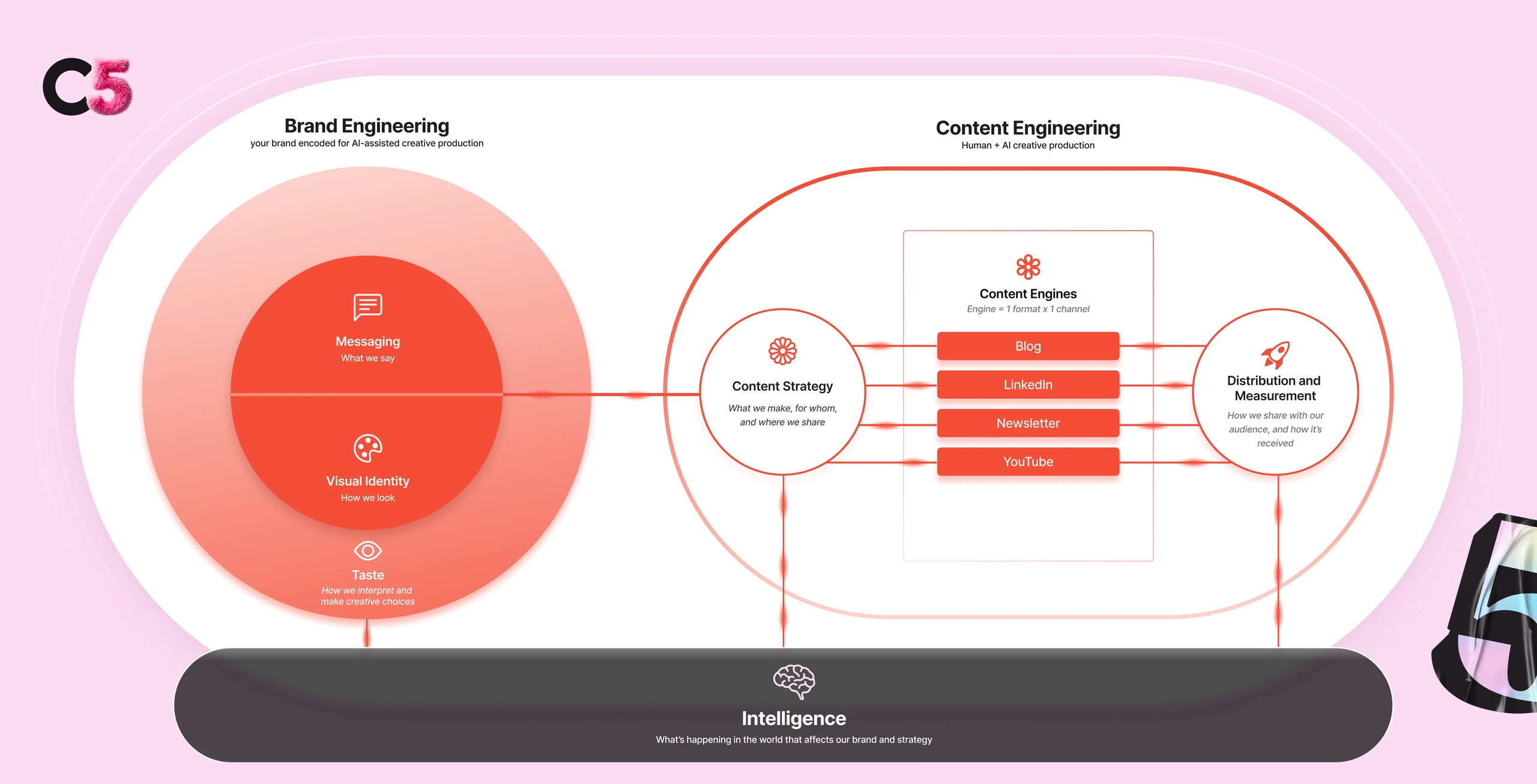

This guide covers the difference between brand voice and brand tone, why voice consistency has become a structural business requirement in the age of AI-generated content, and how B2B brands can define a voice that holds across every channel, team member, and content tool.
What Is Brand Voice?
Brand voice is the consistent personality your company expresses through written and spoken communication. It is the verbal identity that makes your brand recognizable whether someone reads a blog post, a product notification, a sales email, or a social caption. If your audience cannot tell who is speaking when the logo is removed, the voice is not doing its job.
Most definitions stop there. They describe brand voice as a set of adjectives (“friendly,” “authoritative,” “approachable”) and move on to examples. That framing misses the point. Brand voice is verbal architecture. It is the structural foundation that determines whether your content holds together when multiple writers, agencies, and now AI tools are producing it simultaneously. A list of adjectives on a slide deck does not scale. A documented, operational voice system does.
This distinction matters more today than it did five years ago, because the number of hands (and systems) producing content for any given brand has grown dramatically. Your voice is no longer just how you sound. It is the governing constraint that keeps everything coherent. If you are building or refining your brand strategy, start with the strategic foundation before defining the verbal layer.
Brand Voice vs Tone: The Actual Difference
Voice and tone are related, but they operate at different levels.
Voice is your identity. It stays the same regardless of context. If your brand voice is precise and opinionated, it is precise and opinionated on your homepage, in your documentation, and in your quarterly earnings call. Voice is structural. Changing it means changing who you are.
Tone is the emotional inflection you apply to that voice depending on the situation. Same voice, different energy.
Here is how this works in practice for a B2B SaaS company with a voice that is direct, knowledgeable, and slightly informal:
| Context | Voice (constant) | Tone (shifts) |
|---|---|---|
| Blog post on industry trends | Direct, knowledgeable, slightly informal | Confident, forward-looking |
| Error message in the product | Direct, knowledgeable, slightly informal | Calm, reassuring, helpful |
| Case study | Direct, knowledgeable, slightly informal | Measured, evidence-focused |
| Social post celebrating a milestone | Direct, knowledgeable, slightly informal | Warm, energized |
| Sales follow-up email | Direct, knowledgeable, slightly informal | Personable, consultative |
The voice never changes. The tone always does. Think of it this way: a person’s personality stays consistent whether they are celebrating a win or delivering hard news. The words they choose and the energy they bring shift with the moment. Brand tone works the same way.
The mistake most brands make is defining tone without first defining voice. They produce a list of situational guidelines (“be empathetic in support emails, be bold in ads”) without establishing the underlying personality those guidelines express. The result is content that sounds like it was written by different companies depending on the channel.
Why Brand Voice Matters More Now Than Ever
Brand voice has always been important for differentiation and trust. What has changed is the structural role it plays.
The consistency gap was already wide before AI arrived. Research from Envive’s 2026 brand voice study found that 60% of marketing materials fail to conform to brand guidelines, and 81% of companies struggle with off-brand content despite having documented guidelines. The problem is not a lack of awareness. The problem is that most voice guidelines are aspirational documents, not operational systems.
AI tools accelerated the gap. According to a 2026 WorkfxAI comparison study, 85% of marketers now use AI writing tools for content production. Those tools are fast. They are also indifferent to your brand voice unless you have built the infrastructure to constrain them. Teams that deploy AI content tools consistently report that visual brand consistency (colors, logos, layouts) holds up well, but verbal consistency collapses. The logos look right. The words sound generic.
The revenue impact is measurable. Gitnux’s 2026 Brand Consistency Report found that consistent brand presentation across channels increases revenue by 23 to 33 percent. That number predates widespread AI content adoption. As the volume of brand content scales through AI, the revenue impact of consistency (or the lack of it) scales with it.
This is an infrastructure problem, not a creative one. The brands that maintain voice consistency at scale are not the ones with the best copywriters. They are the ones that have turned their voice into an operational system: documented, structured, and enforceable across every person and tool that produces content. For a deeper look at why technical optimization alone is not enough, and how AI is already reshaping content strategy, those pieces provide useful context.
How Brand Voice Affects AI Search Visibility
Here is a dimension of brand voice that almost nobody talks about yet: AI platforms use your content footprint to decide whether and how to recommend you.
According to Wynter’s 2026 B2B Buyer Research, 84% of B2B buyers now use AI tools for vendor discovery, up from 24% just twelve months ago. When a buyer asks ChatGPT or Claude to recommend a content marketing agency, or a SaaS platform for their industry, the AI synthesizes everything it has indexed about each brand. Blog posts, landing pages, case studies, social presence, third-party mentions.
Brands with a consistent, distinctive voice across that content footprint give AI platforms a clear signal: this company has a coherent story, a defined expertise, and a recognizable way of communicating. That clarity translates into citations, recommendations, and visibility.
Brands with scattered messaging, a voice that shifts between every blog post and landing page, generic language that sounds like every competitor’s website, give AI platforms nothing distinctive to latch onto. The result is omission. Not because the brand lacks quality, but because the AI cannot form a coherent picture from the content it has indexed.
This is the new dimension of brand voice strategy. Your voice is no longer only about how humans perceive you. It shapes how AI systems interpret, categorize, and recommend you. If you want to be visible in AI-mediated search, your voice needs to be consistent enough and distinctive enough that an algorithm can identify what makes you different. For more on how AEO and SEO work together, that piece breaks down the relationship in detail.
Brand Voice Examples That Actually Work (Beyond Nike and Wendy’s)
Every brand voice article on the internet uses the same five examples: Nike (bold and motivational), Wendy’s (snarky on Twitter), Apple (minimalist and aspirational), Mailchimp (quirky and friendly), and Innocent (playful and wholesome). These are fine examples. They are also all B2C, and they have been recycled so many times that citing them teaches nothing new.
The real test of a strong brand voice is whether it works in less glamorous contexts: B2B product documentation, compliance-heavy industries, technical audiences who resist marketing language. Below are six B2B brands whose voices you could identify without seeing the logo.
Stripe: Precision as a Trust Mechanism
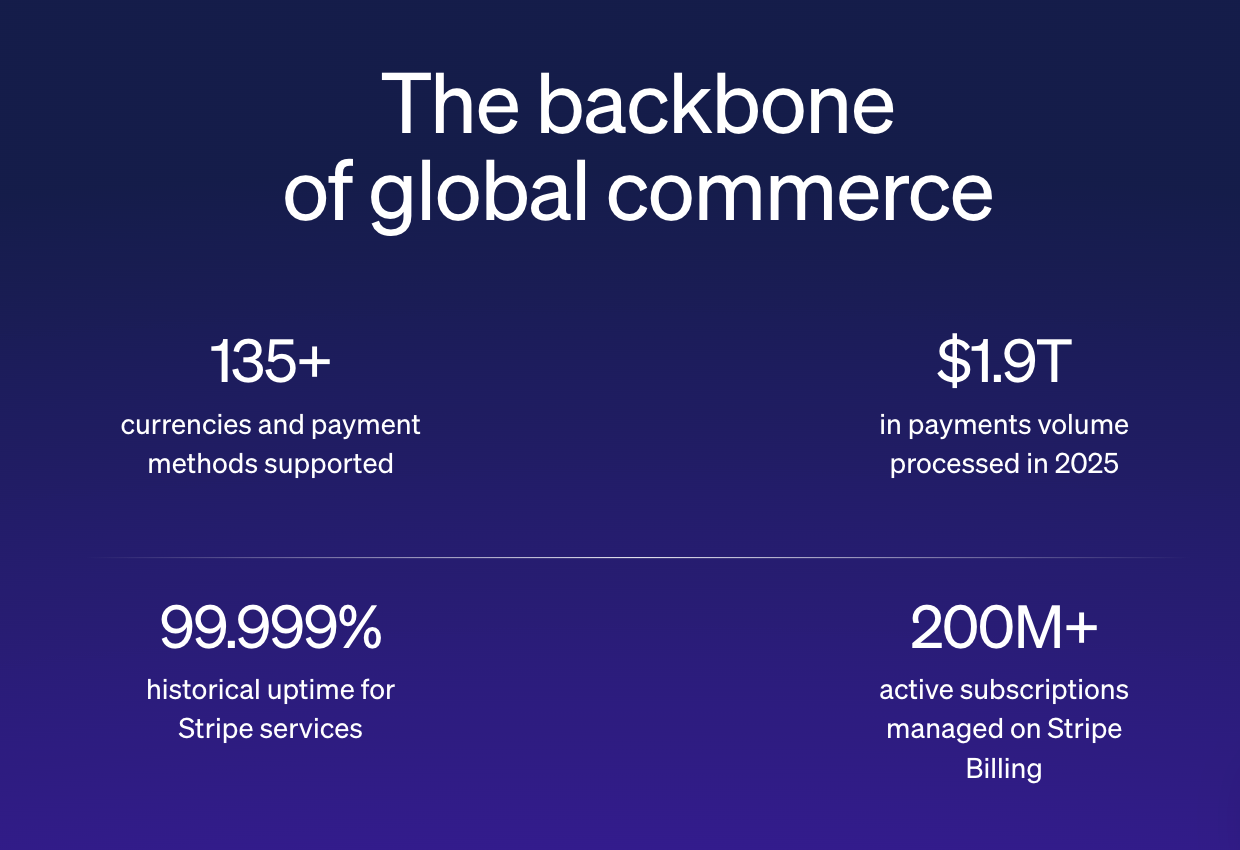
Stripe builds financial infrastructure APIs for internet businesses. Their voice reads like a senior engineer explaining a well-documented system to a peer: precise, compressed, and completely uninterested in persuasion.
The signature move is what they leave out. The words “revolutionary,” “game-changing,” “seamless,” and “best-in-class” appear zero times across their homepage, documentation, and blog. CTAs are lowercase verb-plus-object: “Start now.” “Contact sales.” No exclamation marks anywhere. Their proof points are quantitative rather than qualitative: “99.999% historical uptime” instead of “incredibly reliable.”
Even their error messages follow the pattern. A card error reads: “The card has expired. Check the expiration date or use a different card.” Clinical diagnosis, not apology. Their server error documentation includes the parenthetical “(These are rare.)” which quietly asserts reliability while acknowledging that failure exists.
This works because Stripe’s buyer is a developer or technical founder who has been condescended to by every enterprise sales deck they have seen. The absence of hype functions as a trust signal: if Stripe will not exaggerate in marketing, they probably will not exaggerate about uptime either.
Gong: Revenue Language for Revenue People
Gong sells revenue intelligence software for sales and go-to-market teams. Their voice sounds like a confident sales leader running a team meeting, not a neutral software vendor writing marketing copy.
The vocabulary is packed with action and accountability: crush, win, confidence, customer reality, revenue engine. The homepage promises to help teams “crush goals, close with confidence” and “Kick busywork to the curb.” Their marketing page sharpens the thesis into four words: “Closest to the customer wins.”
The rhythm is distinctive. Gong’s blog prose moves in emphatic bursts, then interrupts itself for effect: “Hard stop. That’s it. That’s all. Simple. Easy. Hold on. Not so fast, my friend.” That cadence mirrors the operating environment their buyers live in, where coaching, forecasting, and deal reviews happen in rapid verbal exchanges, not polished paragraphs.
This works because the people buying Gong are measured on revenue outcomes and forecast accuracy, not on generic productivity. The voice mirrors how they already talk. It sounds accountable and competitive in the exact idiom of revenue leadership.
Basecamp: Opinions as a Business Model
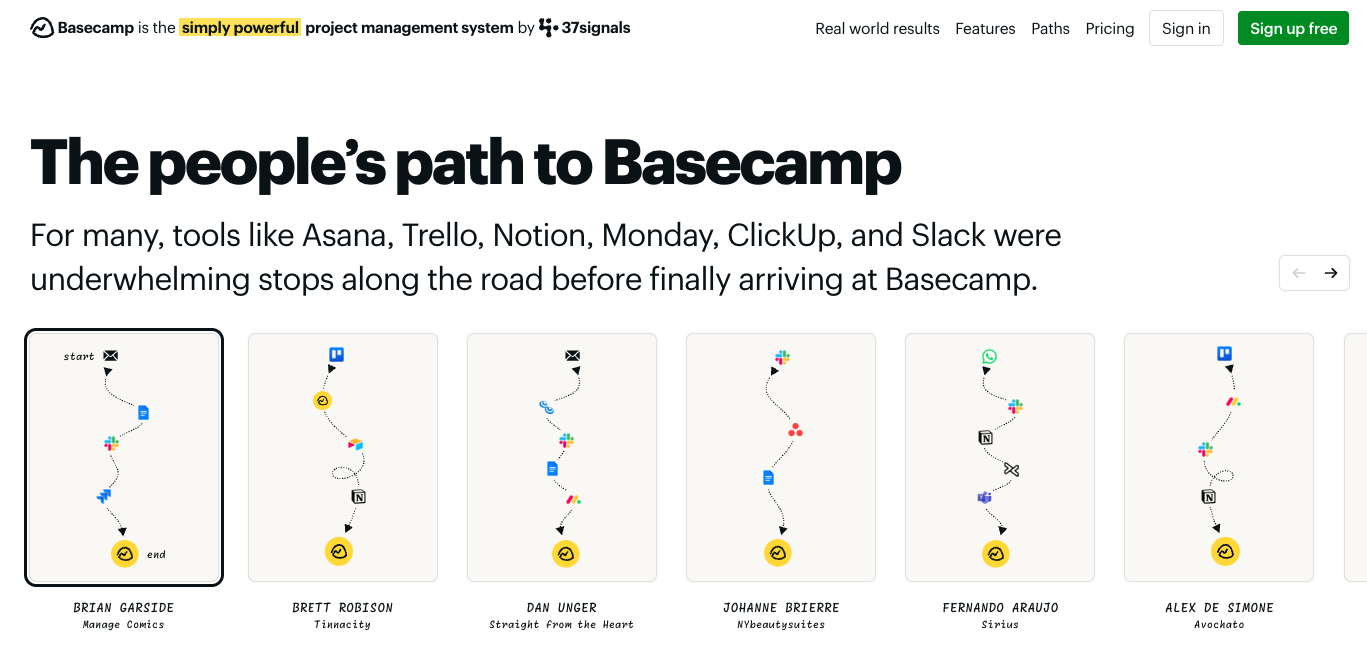
Basecamp sells project management and team communication software with flat pricing, built for small businesses that want simplicity over feature density. Their voice reads like a bootstrap founder telling you exactly what is wrong with the software industry.
The signature is the contrarian frame: state the norm, reject it, offer the alternative. The homepage opens with “Unfortunately, most project management systems are either overwhelming, inadequate, bewildering, or chaotic. You know? Not Basecamp.” Their ONCE product manifesto transforms a pricing model into a moral argument: “You used to pay for it once, install it, and run it. Whether on someone’s computer, or a server for everyone, it felt like you owned it. And you did.”
The about page refuses a polished founding myth: “I wish I could credit a spark of genius, or some deep insight. But I can’t. Truth is, we built Basecamp out of desperate necessity.” This self-deprecation is strategic. It positions Basecamp as someone who has been where you are, not someone selling down to you.
This voice deliberately repels enterprise buyers while creating fierce loyalty among its actual audience: small business owners who feel overwhelmed and overcharged by complex software ecosystems.
Ahrefs: Show Your Work, Then Show It Again
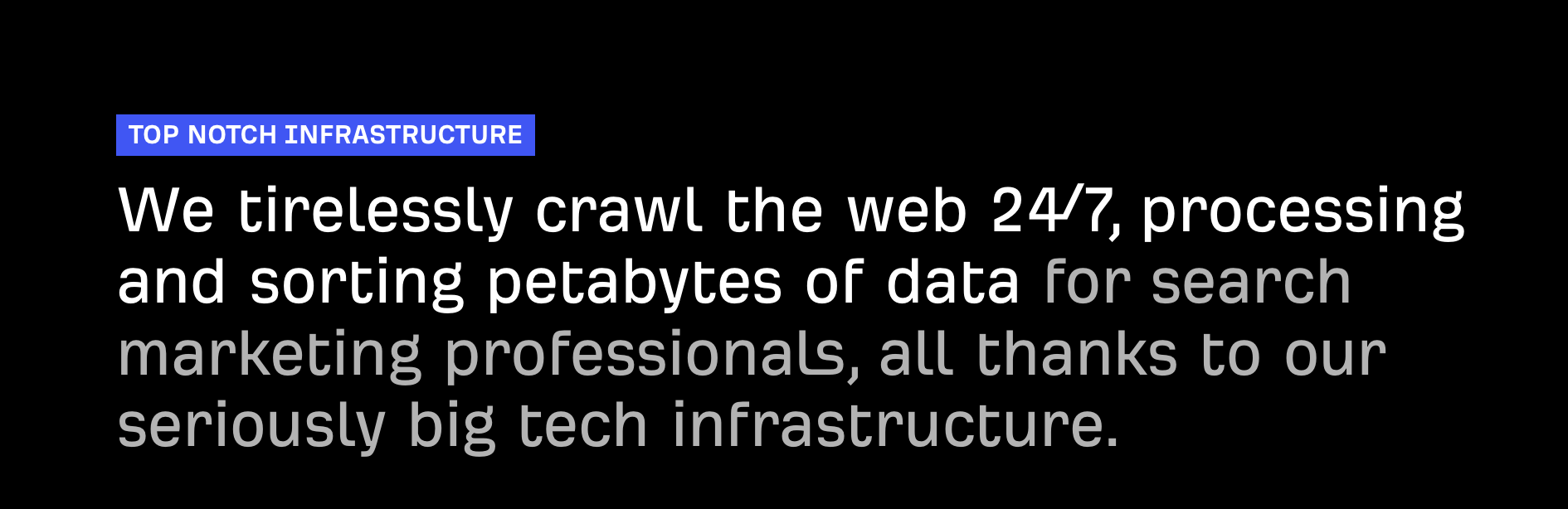
Ahrefs sells an SEO and digital marketing toolset for practitioners who live in data daily. Their voice leads with specific numbers, undercuts its own claims before you can, and refuses every conventional growth marketing tactic.
Blog titles are built around unrounded numbers: “96.55% of Content Gets No Traffic From Google” and “74% of New Webpages Include AI Content (Study of 900k Pages).” The number comes first. Always. Their homepage social proof uses a live counter rather than a rounded figure. They cite the source of their own marketing claims on the marketing homepage itself.
The intellectual honesty extends to self-correction. Their landmark content study includes: “Does any of this data prove that backlinks help you rank higher in Google? No, because correlation does not imply causation.” Ahrefs preemptively undercuts its own research before skeptical readers can. The pricing FAQ states flatly: “We never run discounts.” Three words. Full stop.
This works because SEO practitioners are trained to distrust black-box claims. A voice that shows its methodology and acknowledges its limitations builds credibility faster than one that oversells.
Vercel: Speed as a Verbal Commitment
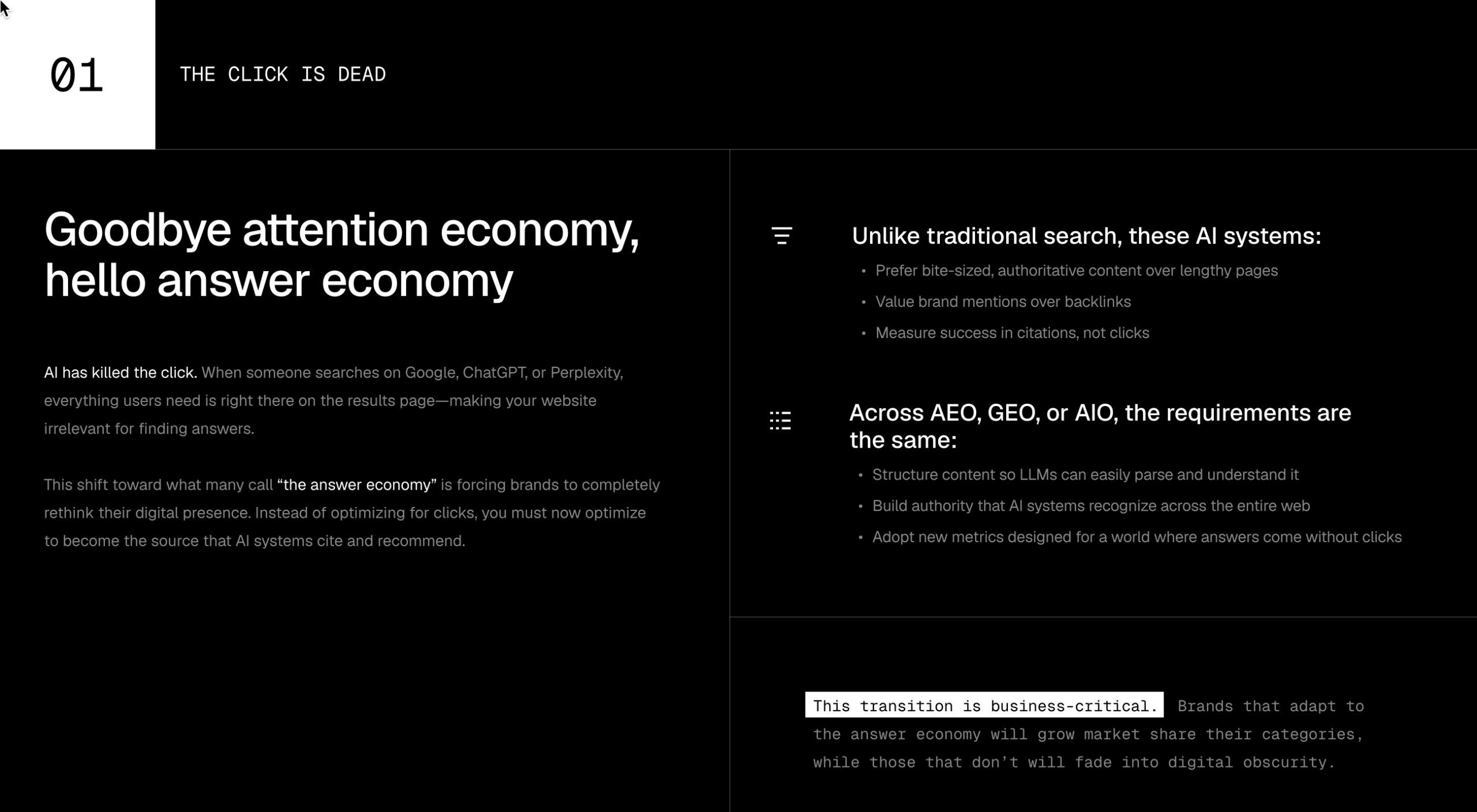
Vercel builds frontend deployment infrastructure and the Next.js framework. Their voice compresses infrastructure concepts into imperative fragments that treat deployment speed as a moral argument.
Product taglines read like terminal output: “Fluid Compute: Servers, in serverless form.” “CI/CD: Helping teams ship 6x faster.” “Observability: Trace every step.” Each rarely exceeds eight words. The three-word tagline “Develop. Preview. Ship.” captures the entire product philosophy and has become cultural shorthand in frontend development.
The verb “ship” is Vercel’s governing keyword, appearing across every surface: homepage, blog, changelog, tweets. CEO Guillermo Rauch’s writing gives the brand its intellectual backbone. From his “AI Cloud” essay: “The cloud promised to remove the burden of maintaining physical data centers and hardware, but ultimately we inherited much of that burden in digital form. DevOps, K8s, VPCs, CI/CD, IAM, CDNs, IaC…” The acronym cascade is deliberately overwhelming. It makes the reader feel the complexity Vercel eliminates.
Vercel’s voice holds even in long-form thought leadership content, where most brands lose consistency. We have seen this firsthand, having built Vercel’s AI thought leadership research reports.
Kit (formerly ConvertKit): Commerce Without Guilt
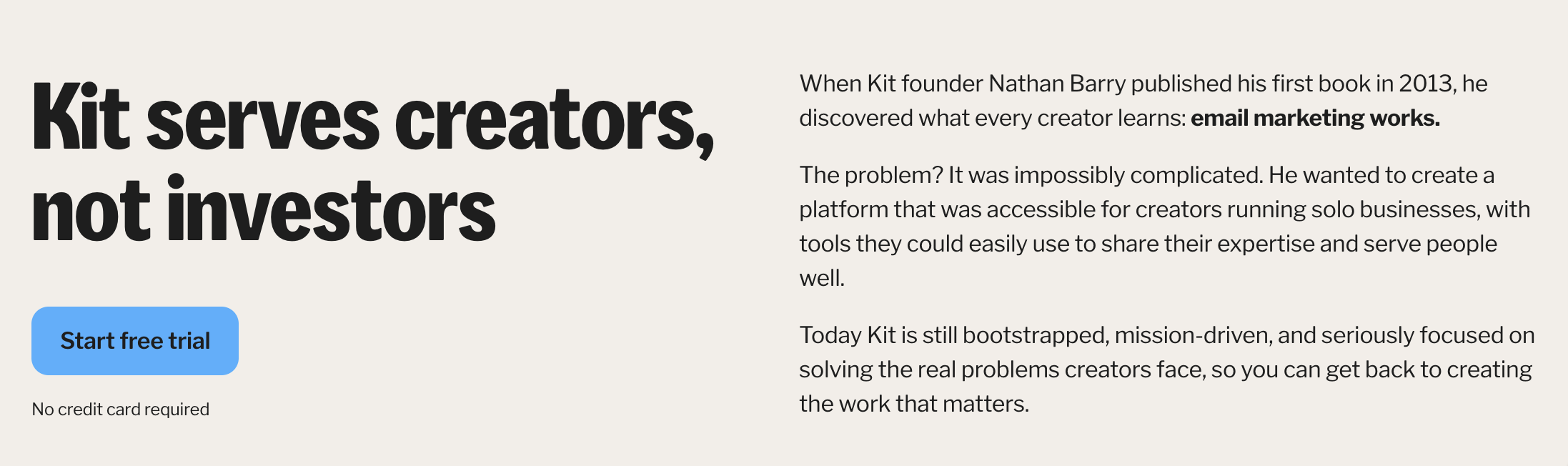
Kit sells email marketing and automation software for creators building businesses around their audiences. Their voice braids together three commitments most SaaS brands keep separate: creator identity, commercial ambition, and emotional sustainability.
The homepage promises creators they can “grow their revenue without burnout” and “Sell more without being salesy.” The automations page extends this with “hands-off revenue” so creators can “focus on the work only you can do.” Even setup documentation frames an opt-in email as a “powerful first impression” that “sets the tone for your list.”
The contrast pairing is their signature device: growth without burnout, selling without feeling extractive, automation without losing yourself. Their subject line guide advises that the best lines should sound “like something you’d say to a friend, not a marketing message.”
This works because creators often experience monetization as identity risk. They want revenue but do not want to feel spammy or dependent on someone else’s platform. Kit’s voice gives them permission to sell while preserving the self-concept they built their audience around.
What These Examples Share
The common thread is not that these companies have “good” voices. Each makes specific verbal sacrifices that competitors will not. Stripe sacrifices enthusiasm. Gong sacrifices neutrality. Basecamp sacrifices diplomacy. Ahrefs sacrifices polish. Vercel sacrifices explanation. Kit sacrifices the hard sell.
Each sacrifice directly serves buyer psychology. Developers trust precision over persuasion. Sales leaders trust momentum over caution. Small business owners trust directness over corporate distance. SEO practitioners trust data over claims. The voice is not decoration applied after the product is built. It is a signal about what kind of company made the product, and whether that company understands the person reading. For more examples of distinctive brand storytelling in unexpected categories, that piece covers additional approaches.
How to Define Your Brand Voice (A Framework That Scales)
Most brand voice exercises start with adjectives. Pick three to five words that describe how you want to sound: “bold,” “approachable,” “authoritative.” That approach produces a poster, not a voice. Here is a framework that actually holds up when six different writers, two agencies, and three AI tools are all producing content under your brand name.
Start with Your Point of View, Not Your Adjectives
A defensible brand voice starts with a defensible point of view. What does your company believe about your industry that most competitors will not say? What do you know from direct experience that your audience needs to hear?
Most companies that struggle with brand voice consistency do not actually have a voice problem. They have a point of view problem. They have not articulated what they believe, so every piece of content reinvents the message from scratch. Adjectives without a point of view produce content that sounds pleasant but says nothing distinctive.
Start here: write down the three to five things your company believes about your space that you would defend in a room full of skeptics. Those beliefs are the foundation of your voice. The adjectives follow from them, not the other way around. For guidance on building the brand story that anchors your voice, that piece walks through the full process.
Identify Your Voice Traits (With Boundaries)
Once you know what you believe, define three to four voice traits that express those beliefs in language. Each trait needs a “this, not that” boundary to be usable.
Example for a B2B analytics company:
| Voice Trait | What This Sounds Like | What This Does NOT Sound Like |
|---|---|---|
| Precise | “Reduces onboarding time by 40%” | “Dramatically speeds up onboarding” |
| Direct | “Here is what changed and why.” | “We are excited to announce some updates.” |
| Grounded | “Based on data from 2,000 accounts” | “Industry-leading insights” |
| Candid | “This feature works well for teams under 50. Larger orgs need the enterprise plan.” | “Perfect for teams of all sizes!” |
The “does not sound like” column is where most voice guides fail. Without explicit boundaries, writers default to safe, generic language that technically fits any brand.
Document for Humans and Systems
Your brand voice guide needs to work for a new hire on their first week and for an AI content tool on its first prompt. If a human cannot follow your voice guide without asking a dozen clarifying questions, an AI tool cannot follow it either.
An operational voice guide includes: the point of view (what you believe), the voice traits with boundaries (how you express it), 10 to 15 example sentences showing the voice applied to common content types, and a short list of words and phrases that are on-brand and off-brand.
Keep it under three pages. A 40-page brand book that nobody reads is worse than a one-page voice card that everyone references. For a step-by-step process on finding and documenting your brand voice, that guide includes a free questionnaire template.
Test Across Channels and Formats
A voice that only works on the blog is not a brand voice. It is a blog voice. Test your documented voice across at least five surfaces before considering it final: homepage, product UI copy, email nurture sequence, social media, and customer support. If the voice breaks on any of those surfaces, the traits need adjustment.
The most common failure point is product UI. Marketing teams define a voice for external content and forget that the product itself speaks to customers more often than the blog does. Error messages, onboarding flows, empty states, and notification copy are all voice touchpoints.
FAQ
What is brand voice?
Brand voice is the consistent verbal personality a company uses across all communication. It includes the vocabulary, sentence structure, and perspective that make a brand recognizable in writing and speech, regardless of the channel or author.
What is the difference between brand voice and brand tone?
Brand voice is constant. It is who you are. Brand tone is variable. It is how you adjust your delivery based on context, audience, and situation. You always use the same voice, but your tone shifts between a celebratory product launch and a sensitive customer support interaction.
Why does brand voice matter for B2B companies?
B2B buying decisions involve multiple stakeholders evaluating a company across many touchpoints over weeks or months. A consistent voice builds trust and recognition across that extended decision process. Inconsistent voice makes a brand feel disorganized, which is a serious concern when a buyer is evaluating you as a long-term partner.
How do you maintain brand voice with AI content tools?
Document your voice in a format that works as system instructions, not just human guidelines. Include specific examples, boundary definitions (what the voice sounds like and what it does not), and a short list of on-brand and off-brand terms. Feed this documentation into your AI tools as context, and build a review workflow that catches voice drift before content publishes. The goal is governance infrastructure, not manual oversight of every piece.
Column Five helps B2B SaaS and AI brands find their unique point of view and build the content systems to express it at scale. If you are ready to build a brand voice that holds across every channel and every tool, let’s talk.




Let's upgrade your marketing game
Get fresh tips, how-tos, and expert marketing advice every week. (15,000 people already are.)