

A content maturity model describes how developed your content system is. At the low end, the brand lives only in your team’s heads. At the high end, it is encoded and portable enough that any person, tool, or agent can create on-brand work. This guide defines the model and walks through all seven stages, from Informal to Intelligent. It also shows how to find your current rung and climb the next one.
Recently we have been mapping how a brand holds together at scale. We defined the content system as the people, tools, and processes that produce on-brand content reliably. It has two halves. The first is brand engineering, your brand encoded so it can travel. The second is the content engines that put it to work. Along the way we went deep on the pieces of an encoded brand, from the messaging layer to encoded taste. This piece ties those threads together. If a content system is the destination, the content maturity model is the map. It shows how far along you are, and what the next step looks like.
What is a content maturity model?
A content system is the people, tools, and processes a brand uses to produce original, on-brand content reliably, at the speed and volume its business demands. We’ve covered this, and surrounding topics, extensively in recent posts.
What our conversations on the topic haven’t done yet is help marketers identify their precise path to scalability.
For example, a marketing org might have its brand guidelines uploaded into a Claude project, but that won’t be sufficient to let non-designers run with content creation.
To provide more context on how to advance a content system, we decided to create a model that runs from a brand carried informally in a few people’s heads (a brand’s starting point) to one encoded and portable enough to run at scale.
The model gives B2B marketers a shared map of where they are, and some guidance as to what better looks like.
Many marketers seem to be struggling with the maturity of their content practice. In a 2024 survey of Fortune 1000 companies, only 12 percent rated their content operations at the top tiers of maturity, according to AIIM research. In fact, the majority sat near the bottom.
This new model aims to give markers some actionable takeaways. When you understand how well your brand is encoded, and how far that encoding can travel.
Why content maturity matters more in the AI era
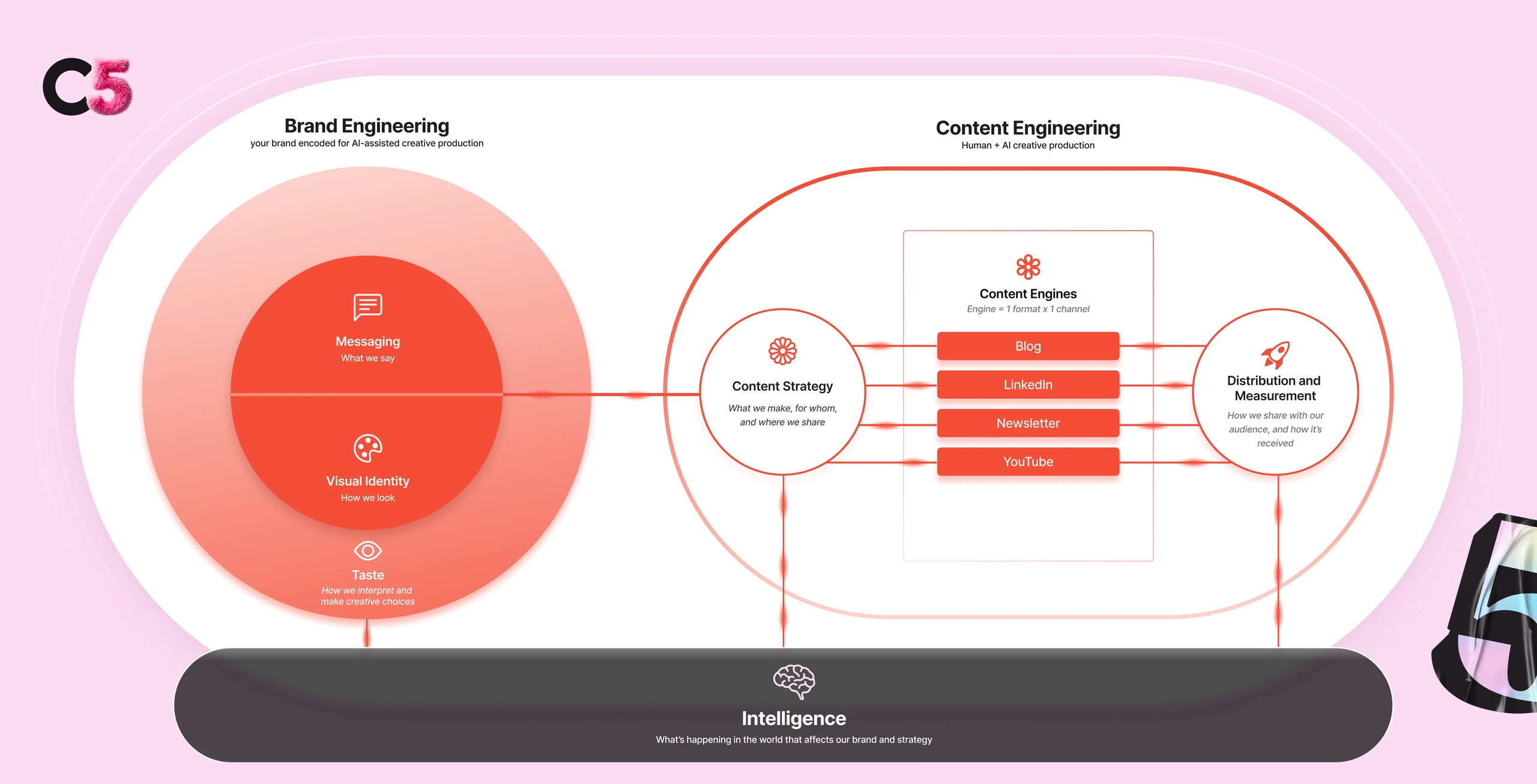
Our diagram of a content system is generally evergreen and AI-agnostic. One of the next steps after understanding your content system is automating the portions of it that make sense for you and your brand.
However, when implementing AI, marketers are continually running into the fact that generative tools pull writing toward a statistical middle. The pull toward the category average makes brand output generic, which we call brand drift.
Consistency is the antidote, and it pays. Presenting a brand consistently across channels can lift revenue by roughly 23 percent.
Thus, what AI changed is the cost of sitting low on the ladder.
Content maturity, of course, isn’t the end goal in itself. Rather, it’s a measure of how completely your brand is encoded, so that whoever, or whatever, creates in your name starts from the right place. The further along you are in your maturity, the more you can entrust non-designers to generate content the way your brand’s creators intended.
The 7 stages of the content maturity model
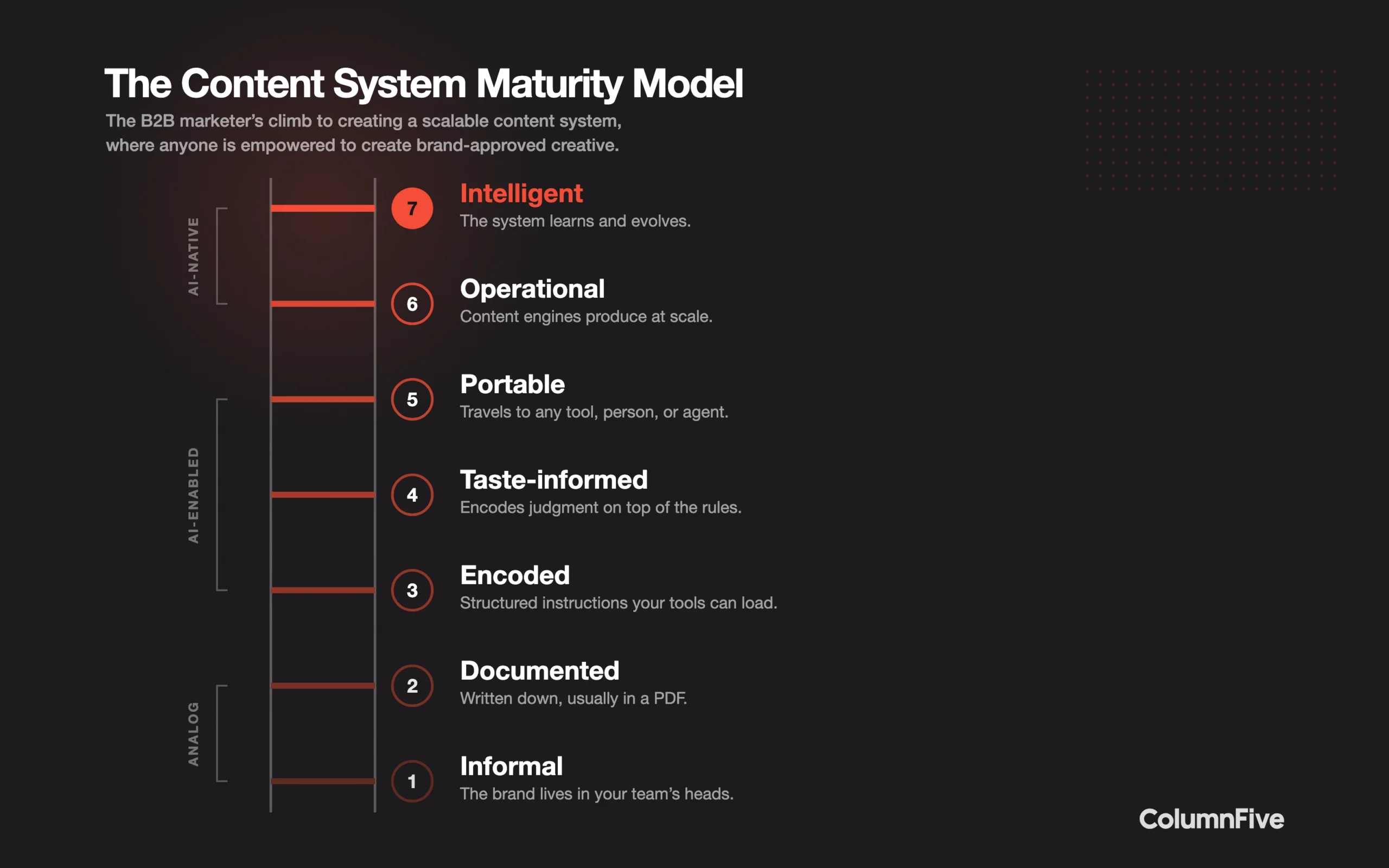
We think of the Content System Maturity Model as a ladder. Each stage is a rung, and you climb them in order, because every rung assumes the one below it is solid. You cannot govern taste you have never written down, just as you cannot make a brand portable before you have encoded it. Here are the seven stages, from a brand that lives in people’s heads to one that learns on its own:
- Informal: the brand lives in your team’s heads.
- Documented: the brand is written down, usually in a PDF.
- Encoded: the brand becomes structured instructions your tools can load.
- Taste-informed: the brand encodes judgment on top of the rules.
- Portable: the brand travels to any tool, person, or agent.
- Operational: content engines turn the brand into repeatable production.
- Intelligent: the system learns from its own performance and the market.
Stage 1: Informal
At the first stage, your brand lives in the heads of your founders and senior creatives. Typically, every asset is a one-off, made from memory and instinct. There are no documented guidelines or key messaging to point to. Work can still be good, since the people carrying the brand are usually talented. It just cannot scale beyond them, and it walks out the door when they do. To climb, you begin with what is already true. Write down the brand decisions living in people’s heads and past work. Teams agree fastest on the anti-patterns, the things you never do, so those are the natural place to start.
How to know you’re in the Informal stage: No documented brand guidelines or key messaging.
Stage 2: Documented
At the second stage, verbal and visual guidelines exist as a real source of truth. The catch is where they live, which is a PDF or a slide deck someone has to remember to open. However, anyone without specialized creative skills struggles to apply them. They do not reach the tools where work actually happens. This is where most teams sit, and where content systems quietly stall. The update cost runs so high that the document goes stale, and people stop trusting it. A guideline nobody opens at the moment of creation cannot govern the thousandth decision. In short, the way up is to encode what you have already written.
How to know you’re in the Documented stage: Documented visual and messaging guidelines. Not encoded or represented in AI or creative tools.
Stage 3: Encoded
At the third stage, the brand gets encoded as structured instructions your tools can load and your team can share. Encoding just means writing the knowledge down in a form a machine can read. That converts it from tribal to institutional. So the guidelines are now present where people create. The limit here is judgment. The system enforces the rules, while interpretation and creative calls stay inconsistent across outputs. Of course, you have compliance, which is worth having. The next rung adds the harder thing, which is judgment.
How to know you’re in the Encoded stage:Source exists to access or download brand and messaging guidelines.
Stage 4: Taste-informed
At the fourth stage, the brand encodes judgment on top of the rules. Taste is disciplined judgment about which creative choice fits a particular brand, audience, and moment. Here you capture it as instructions that sit alongside the guidelines. Over time, the system starts making good calls, and a feedback loop sharpens that taste instead of letting the brand drift. Taste matures through states of its own. A call starts as an observation, becomes a candidate, earns surface approval, and finally becomes canon. That is how correct-but-generic work turns into work that is genuinely yours. Correct is the new baseline, and distinctive is the thing you encode on purpose.
How to know you’re in the Taste-informed stage: Separate set of instructions, based on real feedback from the creative team, are included in the encoded brand for use in creative surfaces.
Stage 5: Portable
At the fifth stage, the brand becomes portable beyond any single platform. It stops being tied to one tool. Instead, it becomes a governance layer that any person, tool, or agent can call to receive the same brand source of truth, everywhere. In practice, that means a versioned source of truth your tools connect to directly, increasingly over a Model Context Protocol (MCP) connection. The brand then loads at the moment of creation, instead of living as a link someone has to remember. Ultimately, portability is what turns four encoded documents into a brand that travels with the work.
How to know you’re in the Portable stage: MCP connection to single source for updated brand guidance
Stage 6: Operational
At the sixth stage, the encoded, portable brand goes into production through content engines. A content engine is the mix of people, process, and tools that produces one format for one channel. For example, think of your blog, a landing page, or a motion-graphics series. Defined workflows plus automation turn the brand into repeatable output at scale. Each engine runs at its own ratio of human to automated work. You know you are here when the team operates one or more semi-automated workflows as a matter of routine. This is also where the roughly quarter of creative capacity lost to version control, asset hunts, and rework starts coming back.
How to know you’re in the Operational stage: One or more semi-automated content creation workflows are built and being operated by the team.
Stage 7: Intelligent
At the seventh stage, the system learns. It evolves the brand deliberately using two kinds of signal. Internal signal comes from your own content performance. External signal comes from the market, your industry, and the wider world. A research function surfaces relevant news and shifts for your team to review. Analytics surface performance insights that feed back into brand and content strategy. This is the Intelligence layer closing the loop, so every cycle starts a little smarter than the last. In practice, very few teams operate here today. Reaching it depends on the measurement infrastructure to connect content to outcomes. It is the difference between a system that compounds and a pile of one-off campaigns.
How to know you’re in the Intelligent stage:Research agent discovers and surfaces relevant signals and news for review and incorporation into brand messaging. Analytics surfaces performance insights of content to incorporate into brand and content strategy.
How to find your rung, and what to fix first
Most teams land at stage two or three, well documented and partly encoded, but still feeling stuck. Finding your rung requires honesty about where the brand actually lives at the moment of creation. If a machine or a new hire cannot load your brand and start from the right place, you sit lower than your PDF suggests.
Importantly, you do not need the system finished to start climbing. A partial system that is portable (i.e., actually present where work happens) beats a complete one sitting in a folder that nobody opens.
We recommend advancing your content maturity in the order of most impactful to brand drift:
- Write down your “anti-patterns” first, since teams often agree fastest on what is clearly off-brand.
- Add your brand claims with a status attached, so everyone knows what is approved, in testing, or off-limits.
- Encode your core narratives.
- Capture the harder taste calls as you make them, one review at a time.
You should find that each item you encode moves you up a rung and makes the next one easier to reach.
Where Column Five fits
We build content systems for B2B marketers across SaaS and AI brands, from the encoded brand that travels to the engines that put it to work.
Our own work with IBM runs as a five-step flywheel.
- A human authors an original point of view
- We encode the brand into the brief
- The system atomizes it into channel-ready variants
- A brand and accuracy gate clears each round
- Performance then feeds the next anchor
In short, it’s a mature content system in motion.
If you want help finding your rung and building to the one above it, let’s talk.
Frequently asked questions
What is a content maturity model?
A content maturity model is a framework that grades how developed a brand’s content system is. It runs from a brand carried informally in people’s heads to one encoded and portable enough that any person, tool, or agent can produce on-brand work. It gives brand and content teams a shared map of where they are and what climbing looks like. Our model measures how well the brand is encoded and how far it travels, which is a different axis from operational efficiency.
What are the stages of content maturity?
There are seven stages: Informal, where the brand lives in people’s heads; Documented, where it lives in a PDF; Encoded, where it becomes structured instructions tools can load; Taste-informed, where it encodes judgment on top of the rules; Portable, where it travels to any tool or agent; Operational, where content engines produce at scale; and Intelligent, where the system learns from its own performance and the market. You climb them in order, since each stage assumes the one below it.
How do I assess my content maturity?
You can find your stage by looking at where your brand actually lives at the moment of creation. The test is whether a new hire or an AI tool could load your brand and start from the right place. If the answer is no, you sit near the Documented stage, however thorough your guidelines are. In practice, most teams land at stage two or three. The fastest way up is to encode your anti-patterns and core claims first.
What is the difference between content maturity and content operations maturity?
Content operations maturity measures how your people, process, and technology run, usually from reactive to optimized. Content maturity, as we define it, measures how well your brand is encoded and how portable that encoding is. That is the axis that determines whether AI tools help or hurt your brand. An encoded, portable brand is what makes efficient operations produce on-brand work instead of more generic output.




Let's upgrade your marketing game
Get fresh tips, how-tos, and expert marketing advice every week. (15,000 people already are.)